
Yomitabi

Japan destinations by region

Yomitabi is a travel journal of Japan off the beaten path, written by someone who lives here: our own visits, our own photos, and the Japanese you’ll read along the way.

Japan’s nine regions
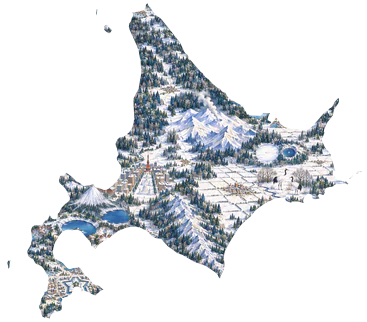
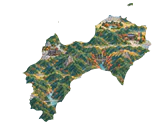
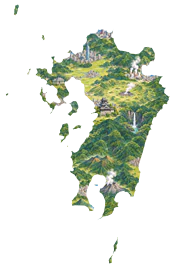
Watercolour of the Hokkaido region of Japan in deep winter: the star-shaped fort of Goryokaku in the snow at Hakodate in the far south, the white cone of Mount Yotei in the west, the orange-red Sapporo TV Tower above a park of snow sculptures, the great white peaks of Asahi-dake with a plume of steam in the centre, two red-crowned cranes on the snow of Kushiro Marsh in the south-east, and dark snow-laden forest and frozen lakes over the whole region.Watercolour of the Tohoku region of Japan: white Hirosaki Castle among apple orchards in the far north, the dark cone of Mount Iwate over the Kitakami valley, the five-storey wooden pagoda of Mount Haguro among its cedars above the Shonai Plain, with snow on Mount Gassan behind it, the wooden inns of Ginzan Onsen along their narrow river, the pine-topped islets of Matsushima beside the modern city of Sendai, the thatched street of Ouchi-juku in the Aizu mountains, and deep green forest and small blue lakes over the whole region.Watercolour of the Kanto region of Japan: the red-and-white Tokyo Tower over the huge modern city around the bay, with the Rainbow Bridge at its head and the Ferris wheel and towers of Minato Mirai in Yokohama on its shore, the Great Buddha of Kamakura on the south coast, the vermilion and gold shrine of Nikko among its cedars in the northern mountains, the steaming hot-spring pool of Kusatsu high in the north-west, the blue flower-covered hill of Hitachi Seaside Park on the east coast, the twin peaks of Mount Tsukuba and Lake Kasumigaura in the flat farmland of the Kanto Plain, and the saw-toothed quarry cliffs of Mount Nokogiri on the Boso peninsula.Watercolour of the Chubu region of Japan: a stone lantern by a garden pond in Kanazawa, thatched farmhouses at Shirakawa-go, the snow-capped Northern Alps above Matsumoto Castle, Nagoya Castle in its modern city, and Mount Fuji with a lake at its foot, among forested mountains and the rice fields of Niigata.Watercolour of the Kansai region of Japan: the pine-lined sandbar of Amanohashidate on the north coast, white Himeji Castle over its city on the coastal plain, the blue water of Lake Biwa, Kyoto's low roofs and five-storey pagoda in their basin with the vermilion torii of Fushimi Inari on the hills beside them, the Tsutenkaku tower over the modern city of Osaka, the smaller cities of Nara and Wakayama, and Nachi Falls with its red pagoda in the forested Kii mountains.Watercolour of the Chugoku region of Japan: the pale golden Tottori sand dunes on the north coast, the lone green volcano of Mount Daisen, the tall dark roof of Izumo Taisha near Lake Shinji, the forested Chugoku Mountains across the interior, the canal and white storehouses of Kurashiki beside the city of Okayama, the domed ruin of the Hiroshima Peace Memorial in its modern city, the vermilion torii of Itsukushima Shrine in the shallows, the five-storey pagoda of Rurikō-ji over the small city of Yamaguchi, and the white limestone rocks of the Akiyoshidai plateau in the west.Watercolour of the Shikoku region of Japan in autumn: the sculpted pines and vermilion bridge of Ritsurin Garden at Takamatsu on the north coast, the gate and pagoda of Ryōzen-ji with white-clad pilgrims in the east, the vine bridge across the Iya Valley in the mountains of the centre, the old wooden bathhouse of Dōgo Onsen and the white castle on its hill at Matsuyama in the north-west, the white keep of Kōchi Castle on the south coast, the Shimanto River and its low bridge in the south-west, and steep dark evergreen forest threaded with autumn colour over the whole island.Watercolour of the Kyushu region of Japan: the slim glass Fukuoka Tower in its modern city on the north coast, the rice fields of the Tsukushi Plain, a white colonial bungalow at Glover Garden above Nagasaki, the rounded volcano of Mount Unzen, the black keep of Kumamoto Castle, the pale green bowl of Mount Aso, columns of hot-spring steam rising over Beppu, a waterfall in the dark gorge of Takachihokyo, the forested Kyushu Mountains, the Pacific coast at Miyazaki, the smoking volcano of Sakurajima facing Kagoshima, and the neat cone of Mount Kaimon in the far south.Watercolour of the Okinawa islands in bright summer: a turquoise sea with a whale shark in the upper middle and a manta ray on the left, and in the lower-right corner a white beach over a pale reef below the red gate of Shuri Castle.
Sapporo札幌
Sendai仙台
Tokyo東京
Nagoya名古屋
Kanazawa金沢
Kyoto京都
Osaka大阪
Hiroshima広島
Takamatsu高松
Fukuoka福岡
Naha那覇
北海道Hokkaido東北Tohoku関東Kanto中部Chubu関西Kansai中国Chugoku四国Shikoku九州Kyushu沖縄Okinawa
Illustrated map of Japan’s nine regions, each painted with its own landmarks.
  1. Japan’s high middle: snow country on one side, Mount Fuji on the other.

    Chubu and the Japanese Alps

  • Hokkaido 北海道ほっかいどう

    Sapporo, Niseko, Otaru, Hakodate, Furano

  • Tohoku 東北とうほく

    Sendai, Aomori, Ginzan Onsen, Hirosaki, Morioka

  • Kanto 関東かんとう

    Tokyo, Yokohama, Kamakura, Hakone, Nikko

  • Kansai 関西かんさい

    Osaka, Kyoto, Himeji, Kobe, Nara

  • Chugoku 中国ちゅうごく

    Hiroshima, Miyajima, Iwakuni, Kurashiki, Onomichi

  • Shikoku 四国しこく

    Takamatsu, Naoshima, Kochi, Tokushima, Teshima

  • Kyushu 九州きゅうしゅう

    Nagasaki, Fukuoka, Kagoshima, Takachiho, Yakushima

  • Okinawa 沖縄おきなわ

    Yonaguni, Naha, Ishigaki, Churaumi Aquarium, Shuri Castle

Japan is usually divided into eight regions. Like most travel guides, we give Okinawa its own, which makes nine.

Learn to read kana before your trip

Hiragana and katakana are Japan’s two alphabets. Learn them first, and menus, station signs and shop names turn from shapes into words you can sound out.

You already know these, in hiragana:

  • こんにちはkonnichiwa, hello
  • ありがとうarigatō, thank you

And these, in katakana:

  • ラーメンrāmen
  • コーヒーkōhī, coffee

New trips, by email

When a new trip goes up, we’ll send you the link.

One email when a new trip goes up, nothing else. Every email has a link to leave. Privacy

How we write these

We went

Every trip is one visit of our own, and its page says which month. We don’t write up a place we haven’t been to.

Our own photos

The photos are ours unless a caption credits someone else. Faces are blurred, and no photo says where or when it was taken.

Facts with a date and a source

Fares, hours and travel times say the day we checked them and link the page they came from.

The Japanese you’ll read there

Station names, onsen signs and menus as they are written, with furigana. Tap a word for its meaning, or save a trip’s words to study before you go.

Written by Maxime Pitaval
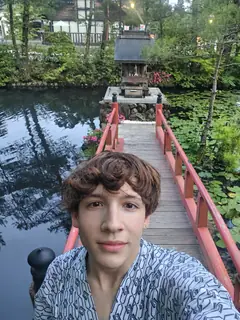
Maxime in a yukata on a red footbridge to a small shrine in Koyasan

I first came to Japan in 2023 on a two-week organised tour, came back in 2025 for a month on my own, and have lived in Tokyo since January 2026. I only write up places I’ve been to myself: the photos are mine unless a caption credits someone else, and every practical fact is dated and linked to the page it came from, under Fact checks.

Have a question about a trip, or a place we should see? Ask us.