





Yomitabi
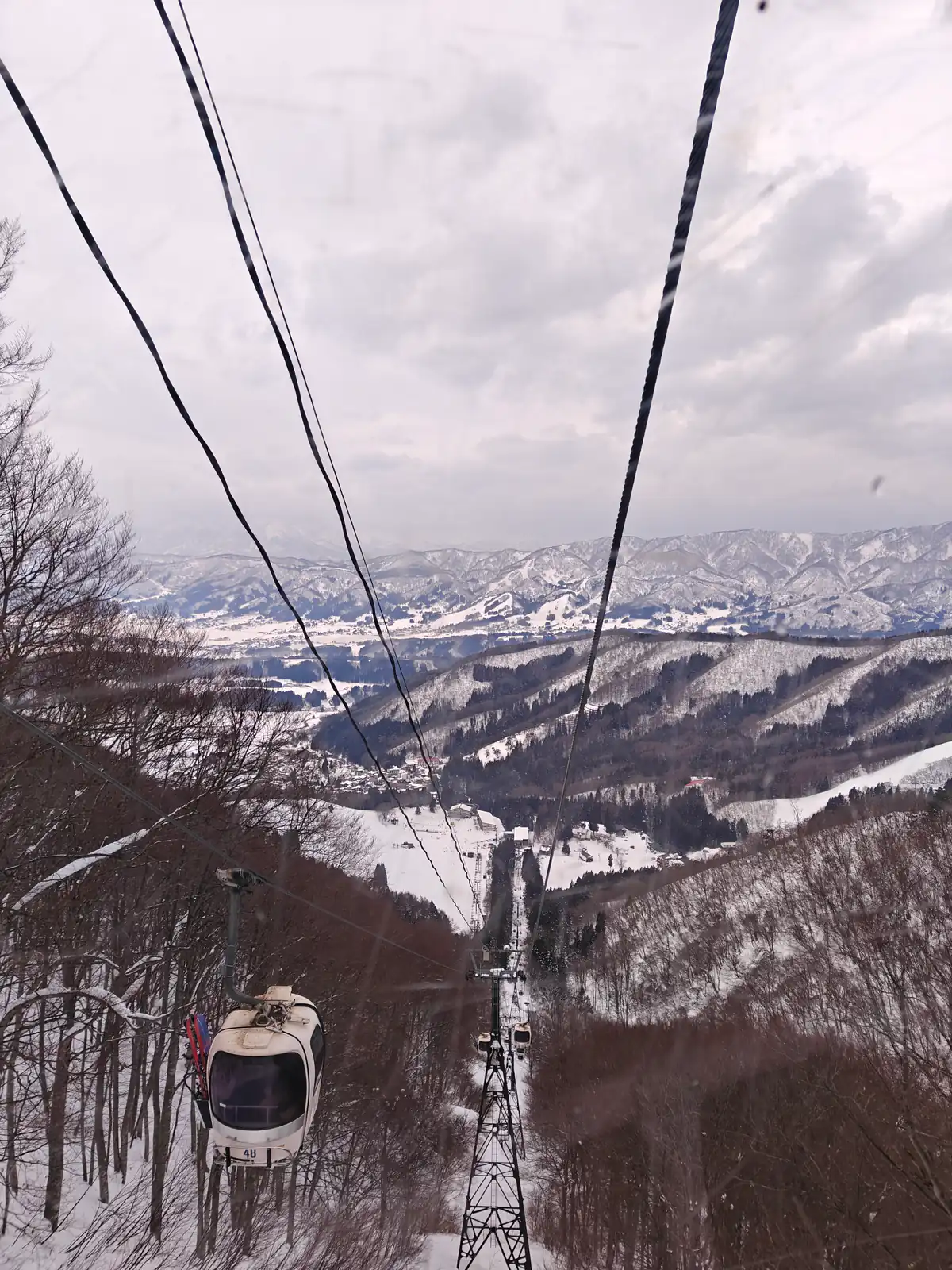
View down a gondola line from a cabin window, with cables and passing cabins leading to a village in a snowy valley ringed by mountains.

By Jan 2026Updated

Nozawa Onsen: Free Baths, Ski and a Fire Festival

Our rating:

How to get to Nozawa Onsen

About 2 h 30 and ¥9,290 from Tokyo, door to door, by Shinkansen and bus.

  1. 東京とうきょう Tokyo

  2. 北陸新幹線ほくりくしんかんせん Hokuriku Shinkansen

    1 h 39 min · ¥8,690
    • JR Passcovered
    • JR EAST PASScovered

    Only the Hakutaka stops at Iiyama.

    Pay: A Shinkansen e-ticket on eki-net; the fare is its reserved seat in the normal season

  3. 飯山いいやま Iiyama

    Board at 千曲川口ちくまがわぐち 4番ばん (Chikumagawa exit, stand 4)

  4. 野沢温泉のざわおんせんライナー Nozawa Onsen Liner

    25 min · ¥600
    • Not covered by the JR Pass

    It does not meet every Shinkansen.

    Pay: Suica, one person a card, or a ticket from the machine

  5. 中央ちゅうおうターミナル Central Terminal

From elsewhere

  • Osaka8 h 50 min · ¥18,975

    Nagano Snow Shuttle coach via Kyoto and Nagano, in winter

  • Haneda Airport5 h 50 min · ¥14,850

    Nagano Snow Shuttle coach via Nagano, in winter

  • Narita Airport6 h 30 min · ¥16,225

    Nagano Snow Shuttle coach via Nagano, in winter

  • Nagano1 h 10 min · ¥4,950

    Nagano Snow Shuttle coach, in winter

  • Hakuba2 h 55 min · ¥9,240

    Nagano Snow Shuttle coach via Nagano, in winter

  • Tokyo by car3 h

    Kan-etsu and Jōshin-etsu expressways to Toyota-Iiyama IC, then Route 117; winter tyres or chains from November to April

Once you’re there

You won’t need a car.
  • Over 200 places to stay cluster around the hot-spring streets, so the baths and sights are a walk away.

  • Yu Road, a free covered moving walkway, climbs from the village to the Hikage base, 8:00–16:40 in winter.

  • A free village shuttle loops between the car parks, the lift bases and the village in the ski season.

  • Coin lockers at the tourist information centre, the Liner's waiting room, the Nagasaka Center House and the Hikage information centre.

  • The ryokan association holds bags.

Plan the exact train

Search 東京 to 飯山 for the times on your day.

Checked 23 October 2026 ·

Where to stay in Nozawa Onsen

One or two days is enough. For the fire festival, stay two nights: you ski on the day, and your inn gives you the entry ticket.

Honkan Gentarōya げんたろう屋や

民宿みんしゅく Minshuku

Really well located, with its own hot spring source. The second night, sukiyaki dinner included.

Where in town

The centre of the village, near the bus stop. There are plenty of ryokan and minshuku to choose from, the bus stop is close, and it's the liveliest part of town. Staying by the Nagasaka gondola isn't worth it: it's under 10 minutes on foot from the centre.

Kinds of place

  • 旅館りょかん Ryokan

    ¥20–35k

    Tatami, futon, dinner and breakfast.

  • 民宿みんしゅく Minshuku

    ¥10–20k

    Family-run, simpler; shared bath.

  • ペンション Pension

    ¥10–20k

    Small Western-style inn, often meals.

  • ホテル Hotel

    ¥20–35k

    Beds and your own bathroom.

  • アパートメント Apartment

    ¥20–35k

    Self-catering, with a kitchen.

Per person, per night · November 2026

Find a room

For the fire festival on 15 January, book several weeks ahead: closer to the day, prices are much higher and everything is full.

Checked 23 October 2026 ·
Best time to visit Nozawa Onsen

Go on 15 January if your dates allow: the fire festival is what sets Nozawa apart, and it’s also the busiest day of the year. Fresh snow isn’t guaranteed: in mid-January 2026 none had fallen for about a week, and this part of Honshu doesn’t get Japan’s most frequent snowfalls.

  • Best time

    Jan–Feb

    Snowy, −5 to 3 °C

  • 桜さくら 16 Apr

    Cherry blossom in full bloom

  • 紅葉こうよう 12 Nov

    Autumn colour on the maples

  • 雪ゆき Dec–Apr

    Snow on the ground, 2 m deep in Feb

Normal dates at 長野ながの (Nagano), 37 km away.

Normals for 野沢温泉のざわおんせん station, 1.2 km away, 1991–2020 ·
MonthSkyHigh / low °CSnowfall
JanSnowy2° / −5°3.7 m
FebSnowy3° / −5°2.8 m
MarSnowy7° / −2°1.7 m
AprMostly sunny14° / 3°35 cm
MayMostly sunny21° / 9°None
JunRainy season24° / 14°None
JulRainy season28° / 19°None
AugMostly sunny29° / 20°None
SepOften cloudy24° / 15°None
OctOften cloudy18° / 9°None
NovOften cloudy11° / 3°16 cm
DecSnowy5° / −2°2.2 m

Festivals and events

What we saw

January 2026

No fresh snow for about a week, and the snow was better off-piste. In the early afternoon the wind rose, and black ice formed near the top of the main slopes. Festival day, the busiest of the year: the village was packed, with a long wait for food even outside peak hours. It isn’t always this crowded.

Crowds

Crowded in season: go early, or on a weekday.

Busy everywhere in Japan: New Year (29 Dec–3 Jan), Golden Week (29 Apr–5 May) and Obon (13–16 Aug).

Is Nozawa Onsen good for skiing?

Right for one or two days of skiing, at any level: a smallish resort, but not a boring one, with some fun off-piste. For a full week, a bigger resort suits better. In mid-January 2026 no snow had fallen for a week, the wind rose in the early afternoon and black ice formed near the top of the main slopes, so the off-piste had the better snow.

Lift passes, 2026–27

PassAdultChildSenior
1 day¥7,800¥4,700¥6,300
4 hours¥6,700¥4,000¥5,350
Night¥2,850¥1,700Not sold
26 Dec–2 Jan, Saturdays 9 Jan–20 Mar, and 10 Jan and 21 Mar
Early season¥5,600¥3,400¥4,500
1 day · Opening to 18 Dec 2026
Spring¥6,100¥3,600¥4,900
1 day · 29 Mar–5 May 2027
2 days¥14,500¥8,700¥11,650
3 days¥21,200¥12,700¥17,000
Ages, deposit and how to pay

A child is junior-high age or younger; one preschooler rides free with each paying adult. A senior is 60 or over.

Passes on an IC card take a ¥500 deposit, refunded when you hand the card back.

The ticket windows take cash, cards, iD, some QR codes and transit IC cards; buying on the web takes credit cards only.

Getting up the mountain

  • Yu Road, a covered moving walkway, carries you from the village to the Hikage base, and it is free.

  • In winter Yu Road runs 8:00–16:40.

  • The Nagasaka gondola climbs from the Nagasaka base to the Yamabiko area in about 8 minutes.

  • The ride down on a gondola is free. A non-skier can ride up on points at ¥750 a point: 5 for the Nagasaka gondola, 3 for the Hikage one.

  • Night skiing runs 16:30–20:00 on the Nagasaka four-seat lift, on the dates under the night pass.

Renting gear

Yes: 12 shops on the resort’s list. An adult ski or board set costs ¥2,000–5,800 a day.

SRS野沢のざわカワヒロ長坂ながさか店てん, a minute’s walk from the Nagasaka gondola: booked online the day before, which is cheaper than on the day, with a QR code to show at the counter, so there was nothing to explain in Japanese. The staff spoke English surprisingly well.

  • 長坂ながさか Nagasaka

    At the Nagasaka base, by the gondola

    5 shops

  • 日影ひかげ Hikage

    At the Hikage base, where Yu Road ends

    4 shops

  • 村内そんない In the village

    In the hot-spring streets

    3 shops

Big boots: ski boots to 34.5 cm at one shop and 33 cm at another; most stop at 31–32 cm.

The resort’s list of shops

Checked 23 October 2026 ·
Onsen in Nozawa Onsen: how the baths work

Yes: 13 free baths, and 2 paid ones at ¥700–900.

How it works here

  • The 13 soto-yu, the village’s public baths, belong to the villagers, who have kept them since the Edo period through their yunakama, the bath-keepers’ groups. Anyone visiting may bathe.

  • Entry is free: leave a few coins in the donation box by the door.

  • The water comes straight from the springs with nothing added to cool it, usually 45–49 °C. You may run in cold water if the other bathers don’t mind.

  • There are no showers or hair dryers.

  • Bring your own towel and soap.

Our favourites

  • 新田しんでんの湯ゆ Shinden-no-yu

    A little outside the centre, so it can be empty when the town is packed. The hottest water of the visit, and hard to get into.

The baths

  • 13 free baths
    • 大湯おおゆ Ōyu

      5:00–23:00 (Apr–Nov), 6:00–23:00 (Dec–Mar)

    • 河原湯かわはらゆ Kawahara-yu

      5:00–23:00 (Apr–Nov), 6:00–23:00 (Dec–Mar)

    • 秋葉あきはの湯ゆ Akiha-no-yu

      5:00–23:00 (Apr–Nov), 6:00–23:00 (Dec–Mar)

    • 麻釜あさがまの湯ゆ Asagama-no-yu

      5:00–23:00 (Apr–Nov), 6:00–23:00 (Dec–Mar)

    • 上寺湯かみてらゆ Kamitera-yu

      5:00–23:00 (Apr–Nov), 6:00–23:00 (Dec–Mar)

    • 熊くまの手洗湯てあらいゆ Kuma-no-tearai-yu

      5:00–23:00 (Apr–Nov), 6:00–23:00 (Dec–Mar)

    • 松葉まつばの湯ゆ Matsuba-no-yu

      5:00–23:00 (Apr–Nov), 6:00–23:00 (Dec–Mar)

    • 中尾なかおの湯ゆ Nakao-no-yu

      5:00–23:00 (Apr–Nov), 6:00–23:00 (Dec–Mar)

    • 新田しんでんの湯ゆ Shinden-no-yu

      5:00–23:00 (Apr–Nov), 6:00–23:00 (Dec–Mar)

    • 真湯しんゆ Shin-yu

      6:00–22:00

    • 滝たきの湯ゆ Taki-no-yu

      5:00–21:00 (Apr–Nov), 6:00–22:00 (Dec–Mar)

    • 横落よこちの湯ゆ Yokochi-no-yu

      6:00–23:00

    • 十王堂じゅうおうどうの湯ゆ Jūōdō-no-yu

      6:00–22:00

  • ふるさとの湯ゆ Furusato no Yu¥700

    10:00–19:00 (Apr to mid-Dec), 11:00–20:00 (mid-Dec to Mar) · Closed Thursdays

  • スパリーナ Sparena¥900

    14:00–20:30 · Closed Wednesdays, except in the ski and pool seasons

Not open to visitors: 麻釜おがま Ogama. The village’s cooking spring, about 90 °C: for villagers only.

Tattoos

No official policy posted (checked 23 October 2026).

The sign at the door

外湯そとゆに入はいる上うえでの心得こころえ

Before you bathe at the soto-yu

  1. 入浴にゅうよく前まえに体からだを洗あらって下ください

    Wash before you get in.

  2. 浴槽よくそうにタオルを入いれないで下ください

    Keep your towel out of the tub.

  3. エチケットを守まもって入浴にゅうよくしましょう

    Mind your manners in the bath.

  4. 入はいれる温度おんどになったら水みずは止とめましょう

    Once the water is cool enough, turn the cold tap off.

  5. 防犯ぼうはん上等じょうとうの理由りゆうにより、深夜しんやの入浴にゅうよくはできません

    For security and other reasons, no bathing late at night.

On the curtains

  • 男湯おとこゆ

    Men’s bath

  • 女湯おんなゆ

    Women’s bath

  • ゆ

    A bath is here

Checked 23 October 2026 ·
What to eat in Nozawa Onsen

野沢菜のざわな Nozawana

Born here: in the 1750s the priest of Kenmeiji temple brought back turnip seeds from Tennōji, and in the cold, snowy village they grew into a new green. Locals call it o-na, or o-hazuke.

Not tried on this visit.

温泉おんせんたまご Onsen eggs

Eggs cooked in the spring water. Visitors cook their own at the egg kettles by Matsuba-no-yu, Jūōdō-no-yu, Kamitera-yu and Kuma-no-tearai-yu.

Not tried on this visit.

On the menu

  • 野沢菜のざわな

    Nozawana, the village’s pickled greens

  • お菜な

    O-na: what locals call nozawana

  • お葉は漬づけ

    O-hazuke: nozawana pickles

  • 温泉おんせんたまご

    An egg cooked in the hot spring

Where we ate

  • 元気げんきバーガー Genki Burger

    ¥1–3k

    Alright, with quite a wait even outside peak hours on festival day.

  • 新杵製菓しんきねせいか Shinkine Seika

    Under ¥1k

    Manju from a small shop: I love manju.

Per person, per meal

More places: the bureau’s list

Checked 23 October 2026 ·
Is Nozawa Onsen worth visiting?

  • Wow factor 感動かんどう

    For the ski resort and the town, a 3: the town is genuinely beautiful, but the traditional onsen town vibe just isn’t there. The fire festival is another story, a 4.5.

  • Food & drink 食しょく

    Nothing genuinely special to eat here. Genki Burger was alright, with quite a wait even outside peak hours on festival day. The village’s own nozawana went untried.

  • Culture & atmosphere 文化ぶんか

    For the town, a 3.5: a lot of the people working there and visiting are foreigners, so the traditional side isn’t there. The vibe is genuinely lively tho: great for bars and for meeting people. The fire festival itself is a 4.

  • Nature & views 自然しぜん

    The views are alright, but not awesome. The town and the slopes aren’t very high.

  • Ease of visit 行いきやすさ

    Routes, fares and time needed are in Getting there.

Worth it if

  • Your dates match the fire festival, on 15 January.
  • You’re travelling with family and want easy, convenient skiing for one or two days in Japan.

Skip it if

  • You want a more traditional onsen town.
  • You’re skiing a full week and want a big resort.

Japan's only village named for its hot springs

Nozawa Onsen is the only village in Japan with 温泉おんせん (hot spring) in its name, and it will always feel a little special to me, as it was my first trip within Japan during winter. I had arrived in Japan one week before, on my working holiday visa. One hour after I first heard about the fire festival and saw how cool and unique this matsuri looked, I had already booked two nights in 民宿みんしゅく (minshuku, family-run inns), and told my language school I'd be skipping class for two days.

The village sits in northern Nagano, at nearly 600 m, in one of the snowiest parts of Japan: a record 107 cm fell here in a single day in 2010. It was first recorded in 1272, and the villagers still have their own self-governing body, 野沢のざわ組ぐみ (Nozawa-gumi), going back to the late Edo period. It's the one behind the fire festival.

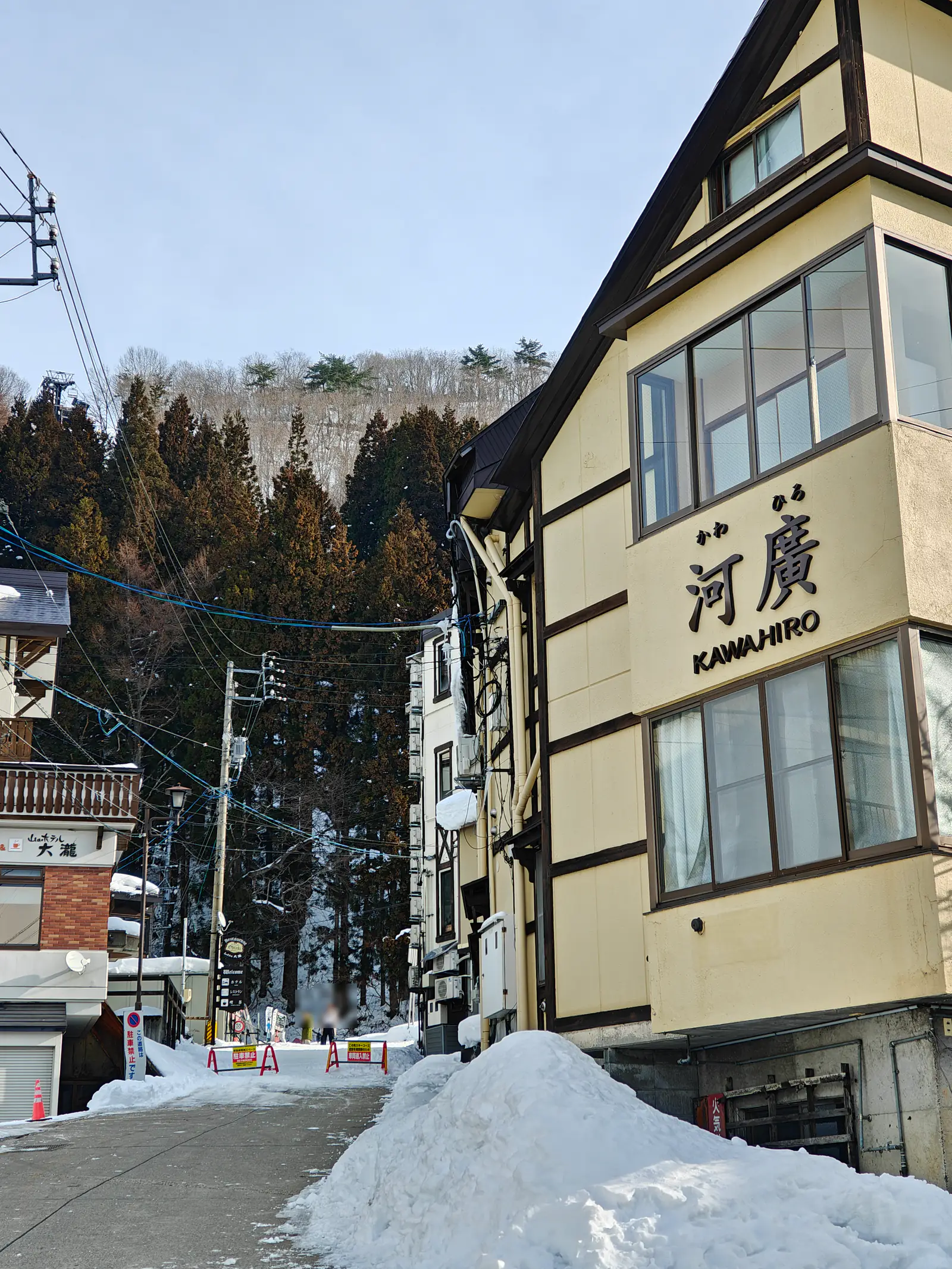
A snowy uphill street with a cream half-timbered building bearing a large name sign on the right, cedar-covered hillside ahead and two small figures by barriers in the distance.
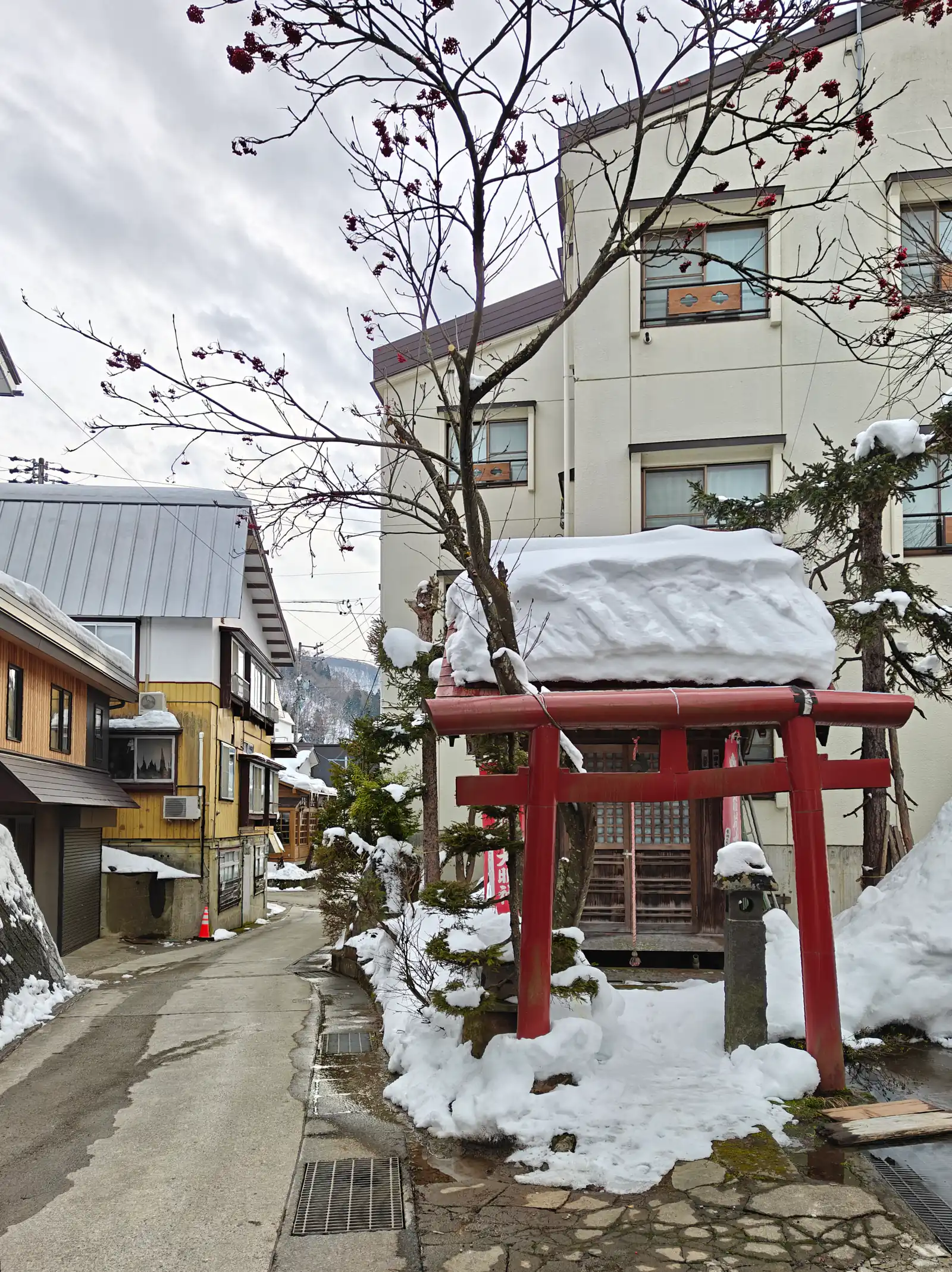
A red torii gate stands before a small wooden shrine with a thick cap of snow on its roof, beside a narrow lane between houses.

The village's year turns on three things: the fire festival every 15 January, the nozawana greens washed in onsen water in late autumn, and the ski season, which is when their pickle is ready.

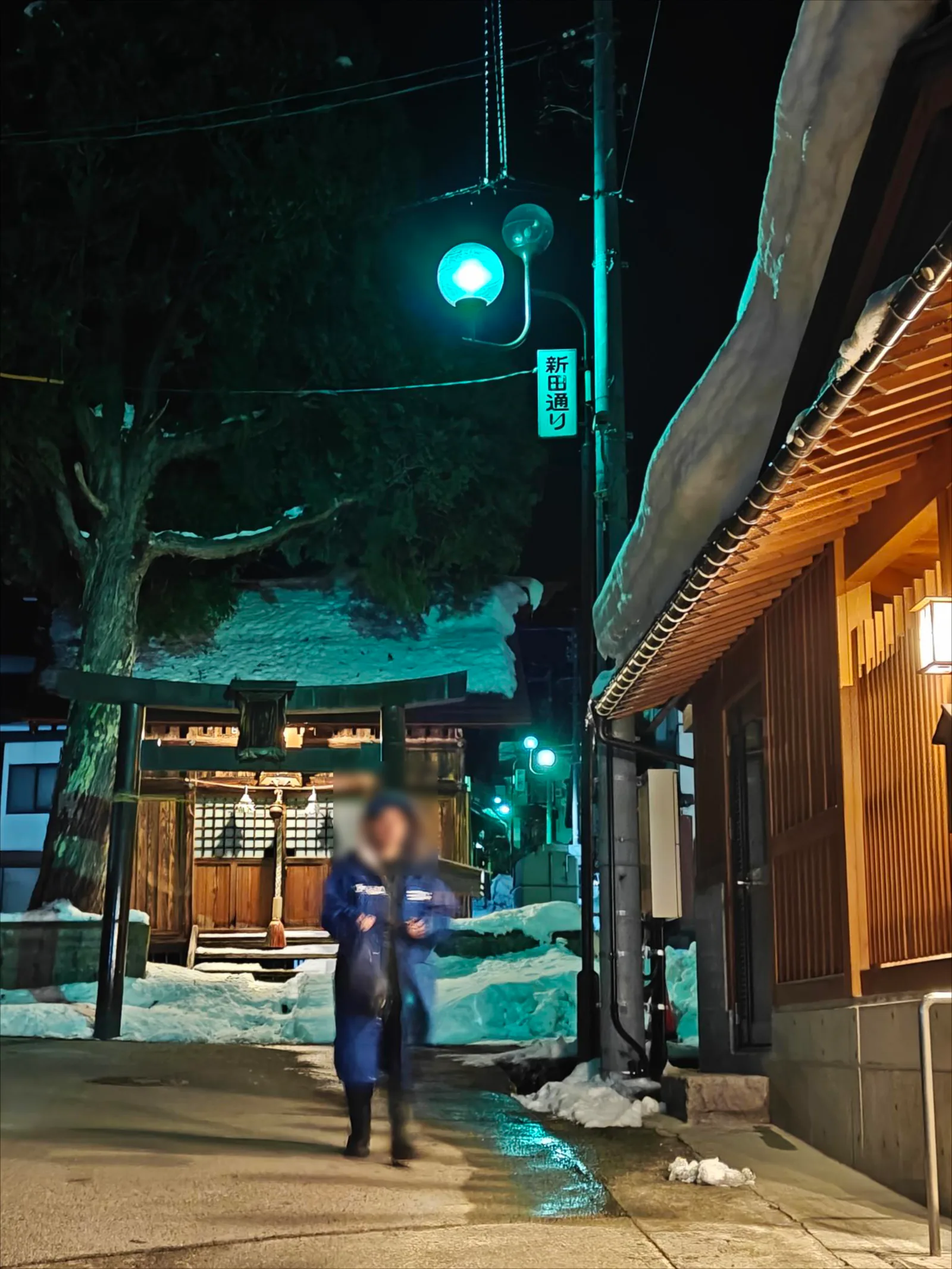
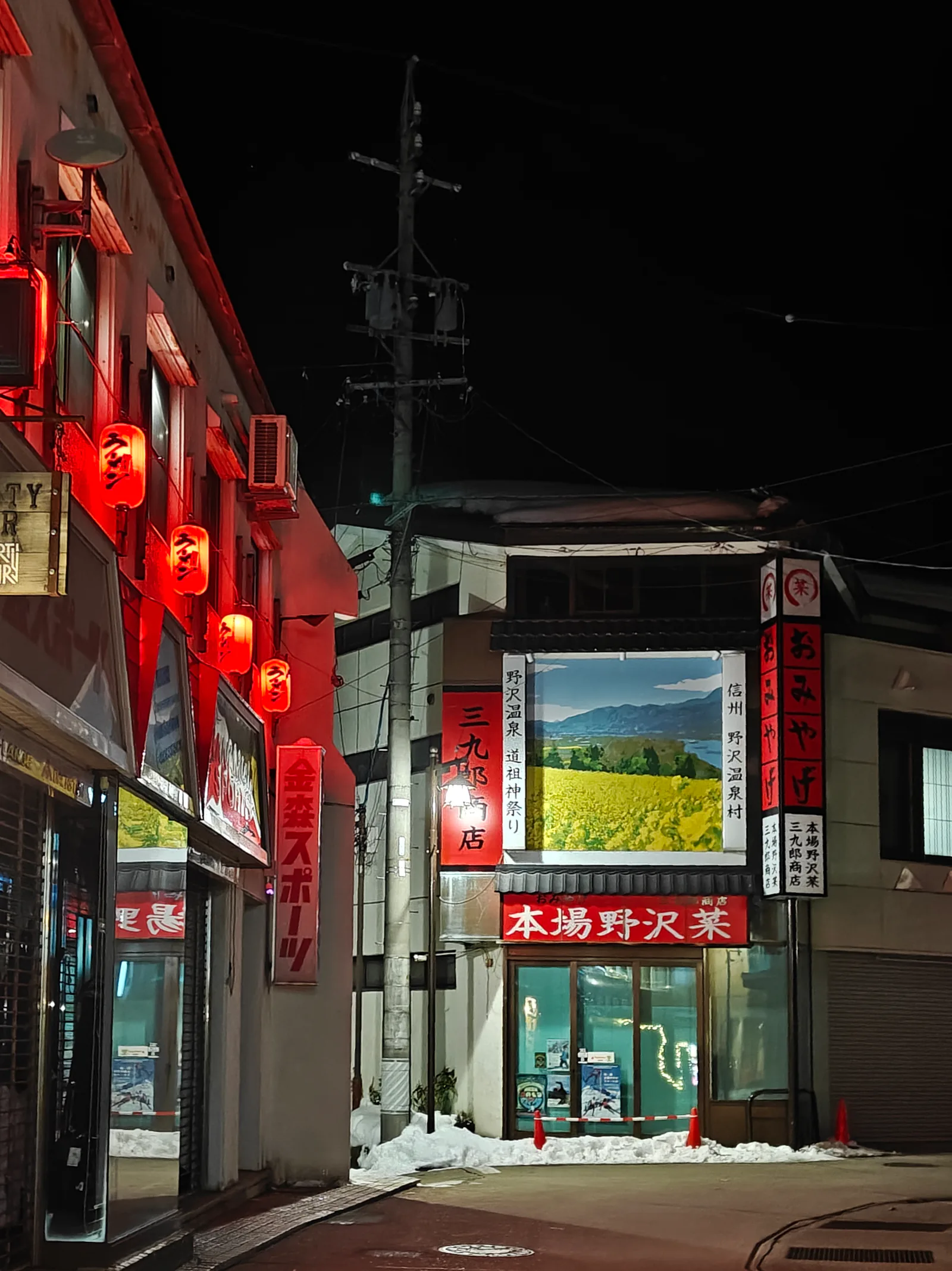
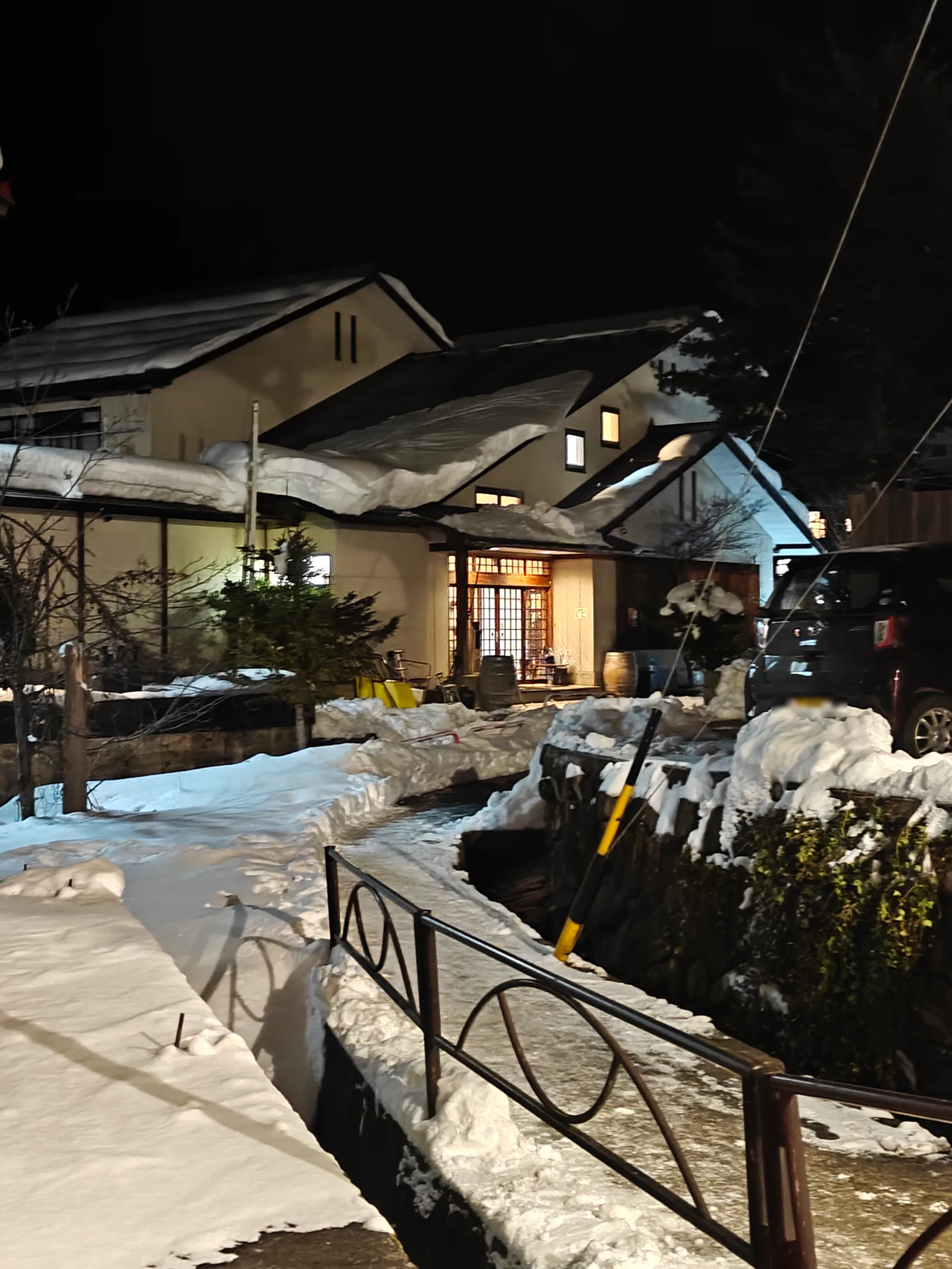
I arrived at night, after a Shinkansen and a short bus ride, and I genuinely loved the atmosphere as soon as I took my first short 散歩さんぽ (walk 😉) around the town. I'm not hard to please tho: I just needed some lanterns, a small shrine and everything surrounded by dozens of centimetres of snow to remind me that I was finally going to ski in Japan.

At night, a person in a blue coat walks, motion-blurred, along a wet lane under a green-lit street lamp, past a snowy torii and a small wooden shrine.
A quiet street at night, with red paper lanterns along a building on the left and a souvenir shop with red signs and a painted landscape panel ahead.
A snow-covered house with a warmly lit wooden doorway at night, seen across a snowy path with a metal railing and a parked car on the right.

My verdict, in short: it was a special trip, and the matsuri is genuinely impressive. But if it wasn't for the matsuri and the proximity with Tokyo, there are more interesting ski resorts in Japan. And as someone who loves traditional Japan, staying in a foreigner bubble on a solo trip wasn't the most marking experience I had here.

So come if your dates match the fire festival, or if you're travelling with family and want one or two easy days of skiing in Japan. Skip it if you want a more traditional vibe, or if you're skiing a full week and want a big resort.

Thirteen free baths, kept by the villagers

My mission on the first night was to find the best of the 13 free public onsen, to save myself from how cold it was outside.

These are the 外湯そとゆ (soto-yu, the communal baths). More than 30 free-flowing sources feed them, and most draw from 麻あさ釜かま (Ogama), the steaming spring in the upper part of the village. The village says a monk named Gyōki found the water in the Nara period, and that at 熊くまの手て洗湯せんとう (Kuma-no-tearai-yu) a wounded bear, chased by hunters, healed itself.

Who keeps the baths

The baths belong to the villagers. Since the Edo period they have kept them as their shared property, through the 湯ゆ仲間なかま (yunakama, the bath keepers' groups). Each bath enshrines the twelve heavenly generals and has an offering box by the door, and a small donation to the yunakama is all they ask.

The most popular one, and the most beautiful from the outside, is 大湯おおゆ (Ōyu), in the main plaza at the centre of the town. It's the village's symbol, and its bathhouse is still built as it was in the Edo period, but it's not as big as I'd thought. These 13 onsen are mostly the same very small bath, where just three or four people can get in at once. And when I opened the door of one of these bathhouses, I was directly face to face with the people bathing there. I discovered this the hard way 😅

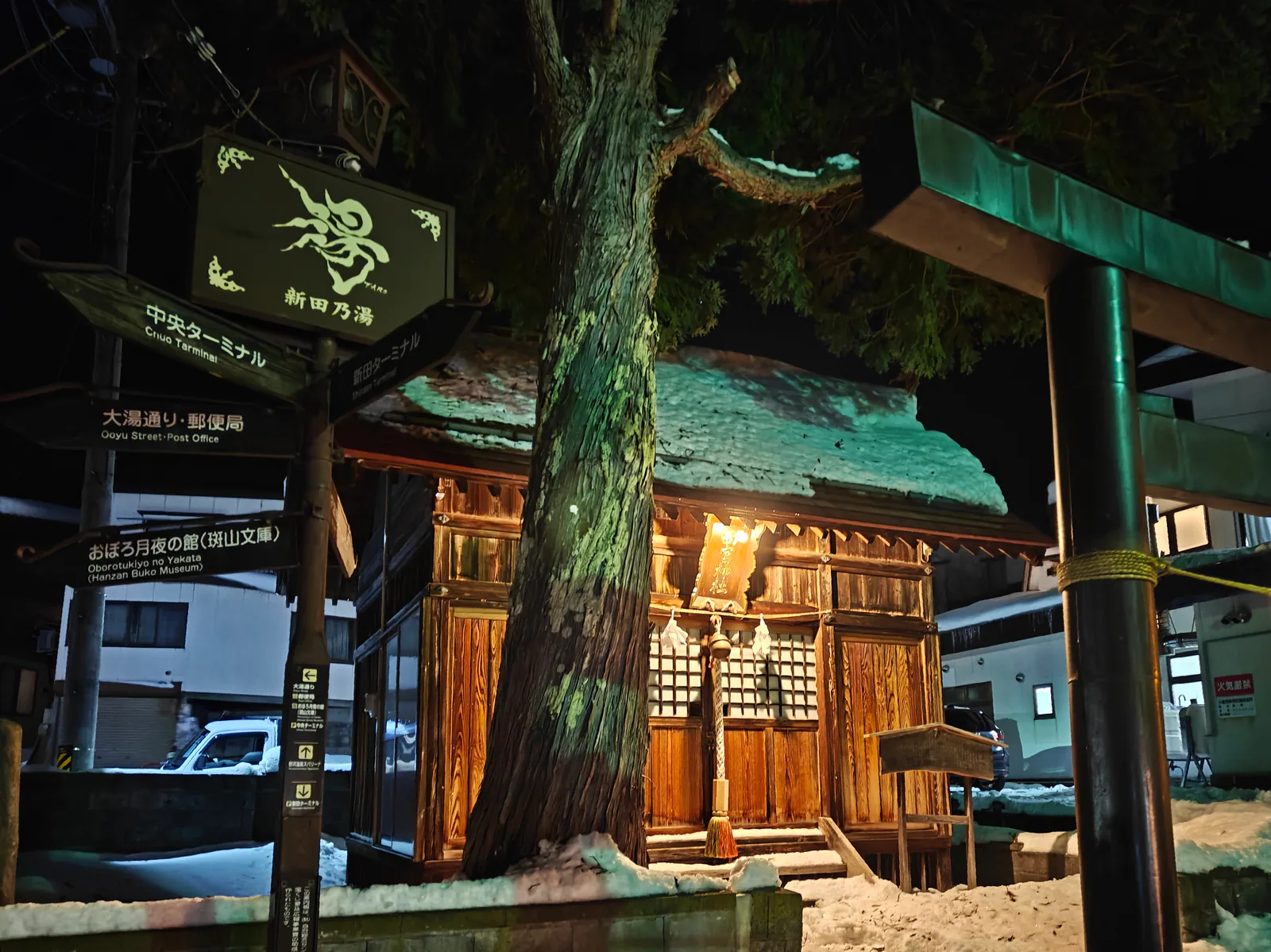
Around the festival, when the town is packed, it can be very, very challenging to find a free onsen among the public ones, especially if you're more than one person. There are also some larger paid onsen, but these were already closed by the time I arrived. I eventually got one for myself, a bit outside the centre of the town, a bath called 新田にったの湯ゆ (Shinden no yu).

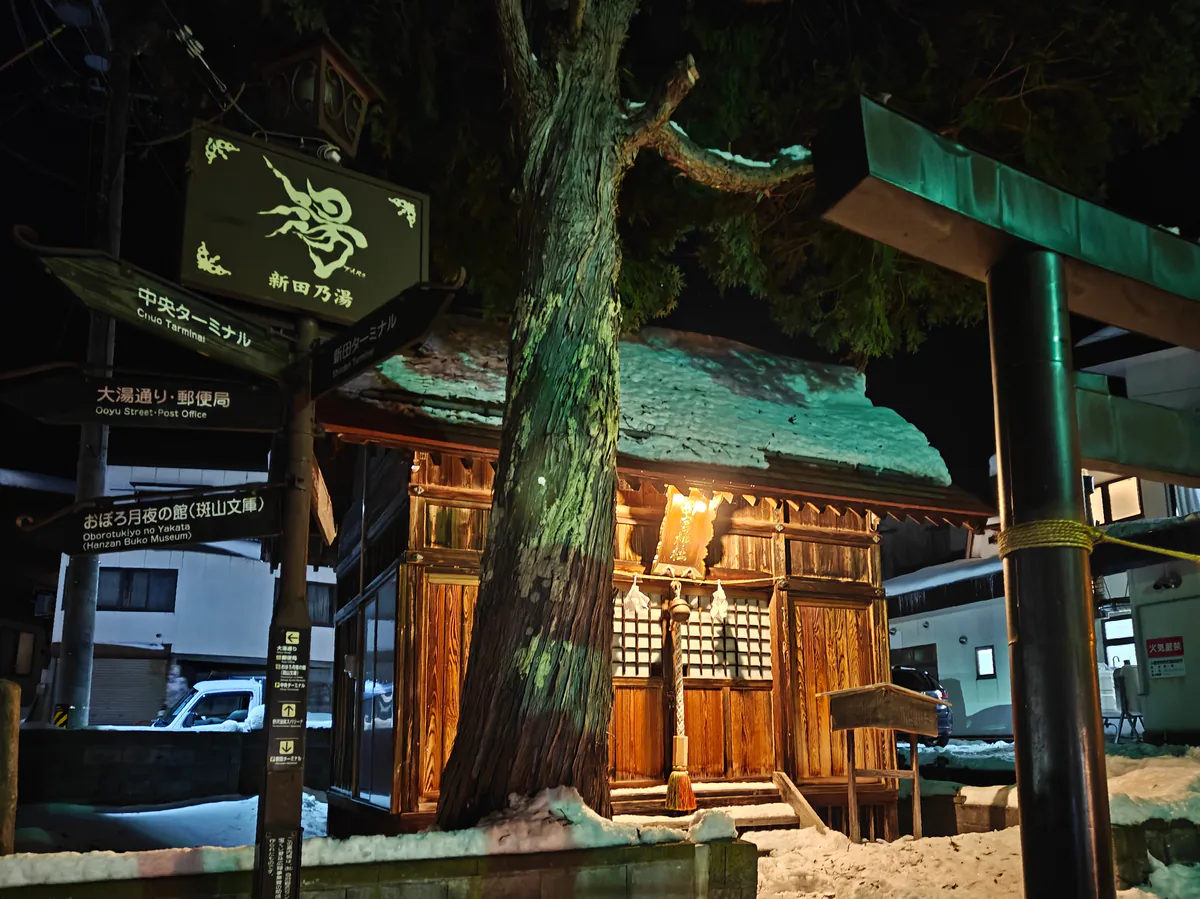
At night, a wooden direction signpost with a large lit bathhouse sign stands beside a small lit shrine, a mossy tree trunk and the corner of a green torii.
The big lit sign reads 新田にった乃湯ゆ, written with 乃 for の: it’s 新田にったの湯ゆ (Shinden no yu).

It was genuinely the hottest onsen I had ever tried. I could hardly get in. 新田にったの湯ゆ is the newest of the 13, in a part of the village opened up at the end of the Edo period, and it was moved and rebuilt in 2018. Like most of them, it's fed from 麻あさ釜かま, where the water comes out at nearly 90 °C, and in the tubs it's typically 45 to 49 °C.

Adding some cold water is allowed, but I wouldn't do it with a Japanese person inside: Japanese people are much more used to very, very hot onsen water !

The village's five rules are short: wash before you get in, no towel in the tub, mind your manners, turn the cold tap off once the bath is bearable, and no bathing late at night. So ask the others before you touch the cold tap, and leave a coin in the offering box by the door. Four of the baths also have an egg pot, where an 温泉おんせんたまご (hot-spring egg) cooks in about 20 minutes, and on the stamp trail, 10 stamps get you a towel.

Ogama, the village kitchen, and nozawana

My best picture of the whole trip is of 麻あさ釜かま at night, the steaming spring in the upper part of the town, and it isn't a bath. It's forbidden to get in, and anyone who tried would be boiled in a minute.

The water comes up at nearly 90 °C, about 500 litres a minute, into five large pools, and for the villagers it's a shared kitchen, where they boil their vegetables and eggs. Only villagers may go in. The village has designated it a natural monument, and the same two kanji are read differently a few steps away: Ogama (おがま) for the spring, but Asagama (あさがま) for the street and the bath beside it.

Nozawa's other famous thing grows in the fields. In the 1750s, the priest of Kenmeiji temple brought back turnip seeds from Kyoto, and sown here, in the cold at nearly 600 m, the story goes, they turned into a new green, 野沢菜のざわな (nozawana). The temple still sells its own seed, and locals just call it お菜さい (o-na).

The greens are washed in onsen water in late autumn, at the laundries six of the baths have, and the pickle is ready from about mid-December, so the ski season is nozawana season. Its first thinnings were once said to taste better than sea-bream sashimi.

I didn't try the nozawana myself. If you come in ski season, the pickle is ready, so try it. And look at Ogama from the street: never step in.

Skiing, here since 1912

Skiing came to Nozawa in 1912, when a village-born pupil of Iiyama's middle school first skied here, and the village's ski club followed in 1923. The Austrian Hannes Schneider later came to show his Arlberg technique in front of hundreds of Japanese skiers, and St. Anton am Arlberg has been the sister village since 1971. Okamoto Tarō made the monument to that link in 1974, and the village's 湯ゆ (hot water) logo is his handwriting.

The village has produced 16 Olympians. In February 2026, Nozomi Maruyama, who trained in the village, took bronze in the women's normal hill ski jump at Milano Cortina, and more than a hundred people in the village watched it live, at 2:40 a.m.

The mountain runs from 565 m at its lowest base to 1,650 m at the top, and the Nagasaka gondola climbs 3,129 m in about 8 minutes. The resort is overall a bit small, but I wouldn't call it boring: it's very enjoyable to ski there, with slopes for all levels and some pretty fun off-piste.

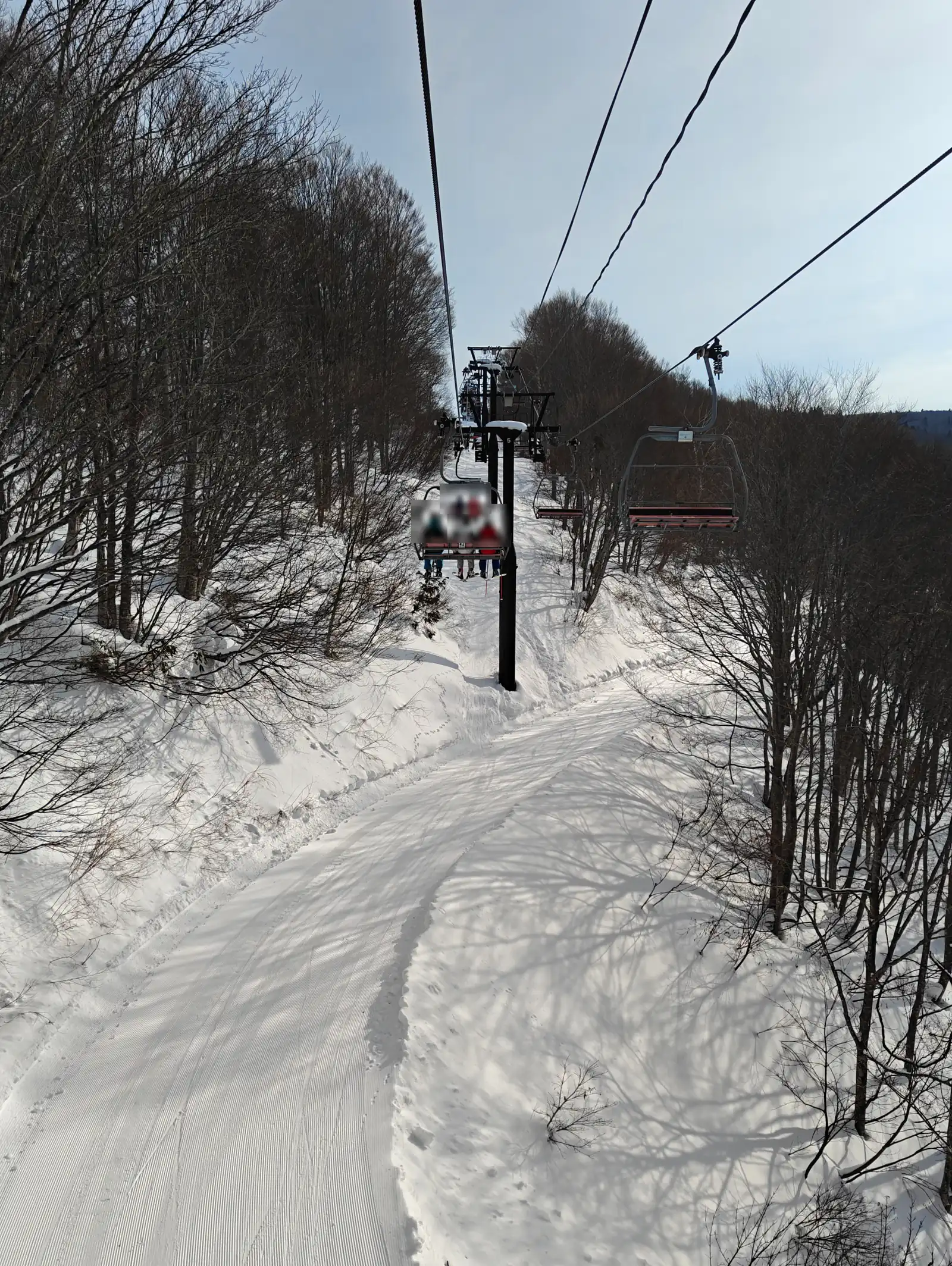
View from a chairlift over a groomed snowy piste between bare trees, with riders seen from behind on the chairs ahead.
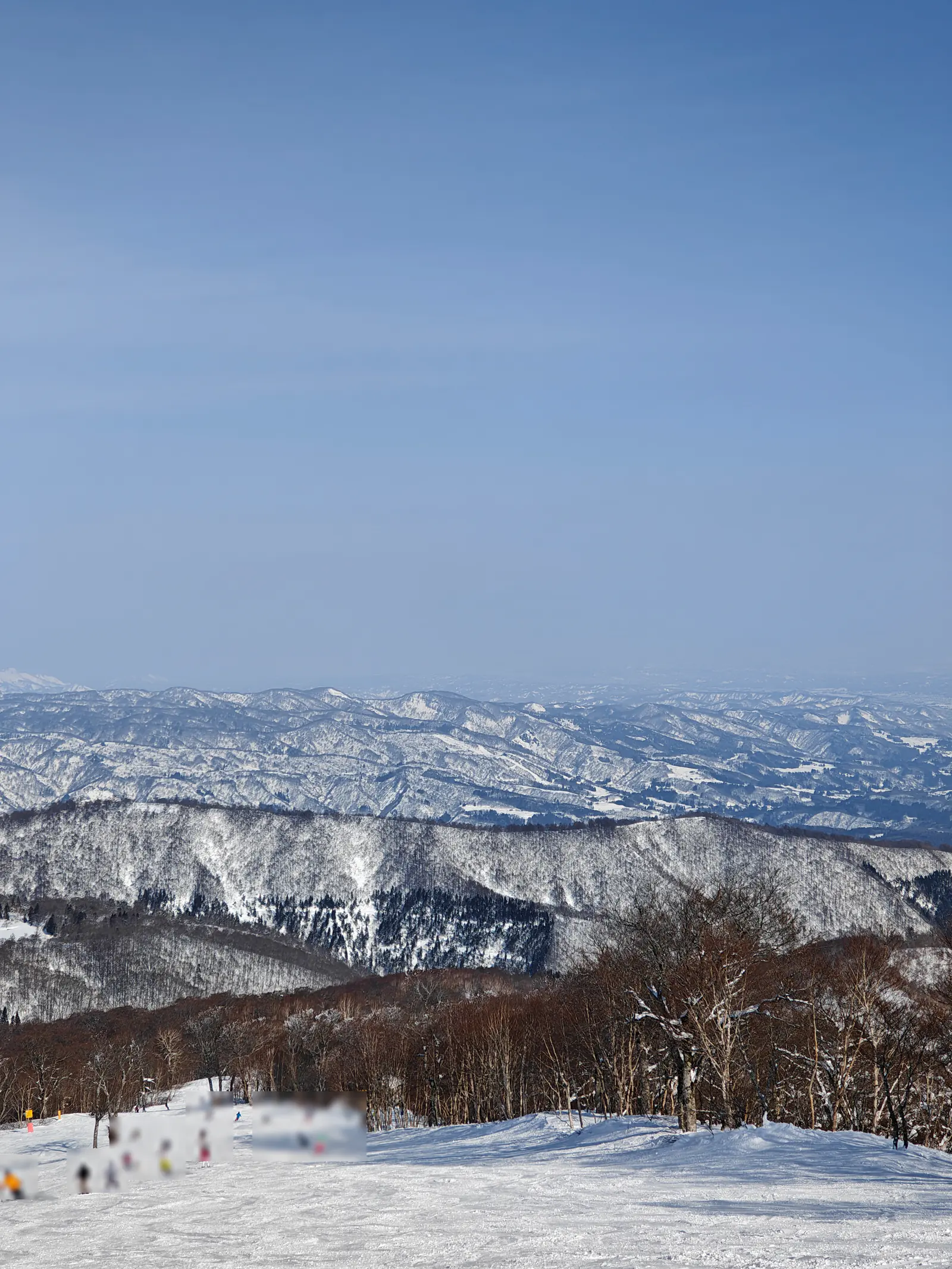
A view down a groomed ski slope dotted with small skiers, past bare brown trees to layers of snow-covered mountain ridges under a clear blue sky.
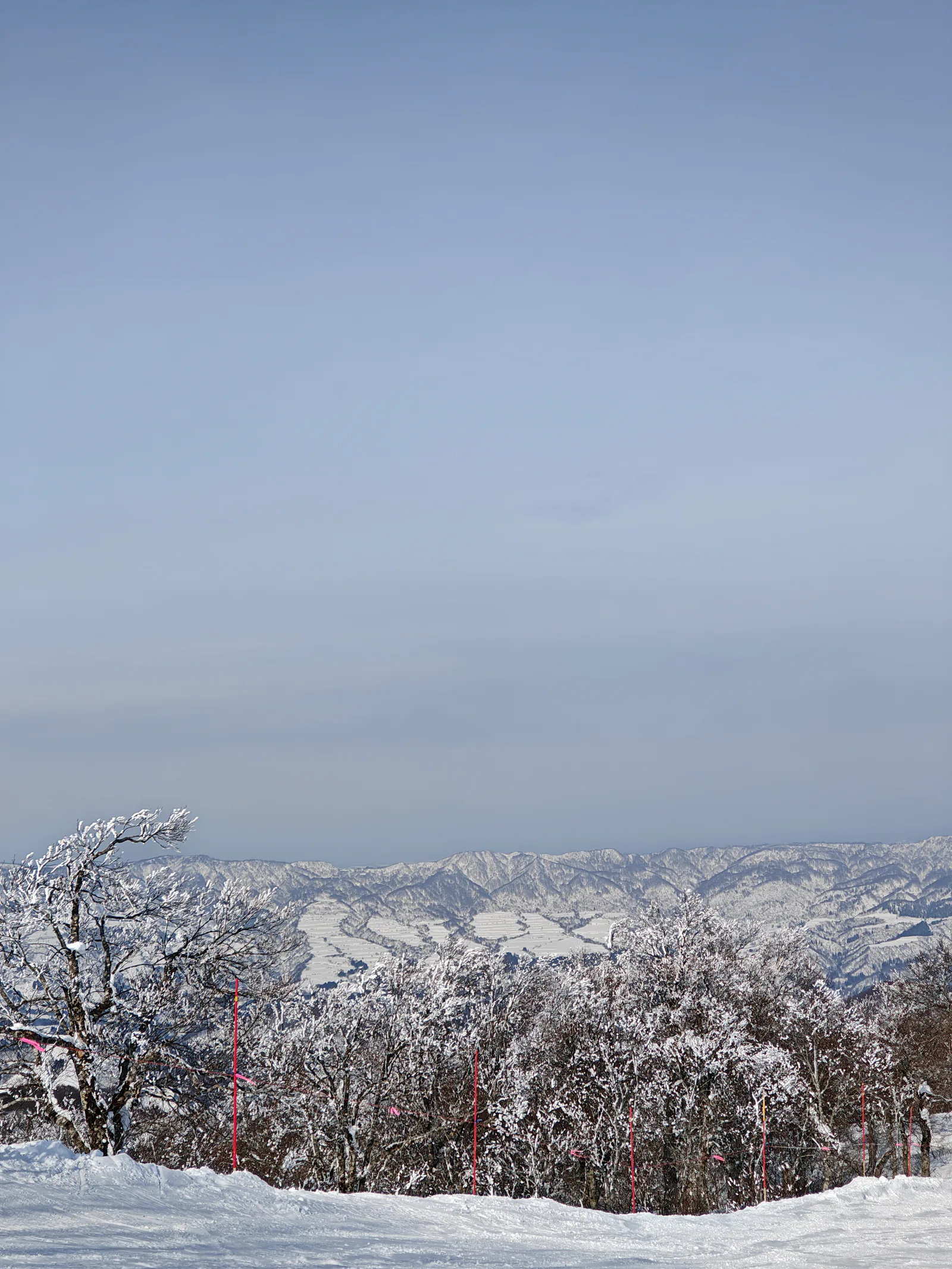
Snow-frosted trees and pink marker poles at the edge of a ski slope, with snowy mountain ridges and a valley below a wide pale sky.
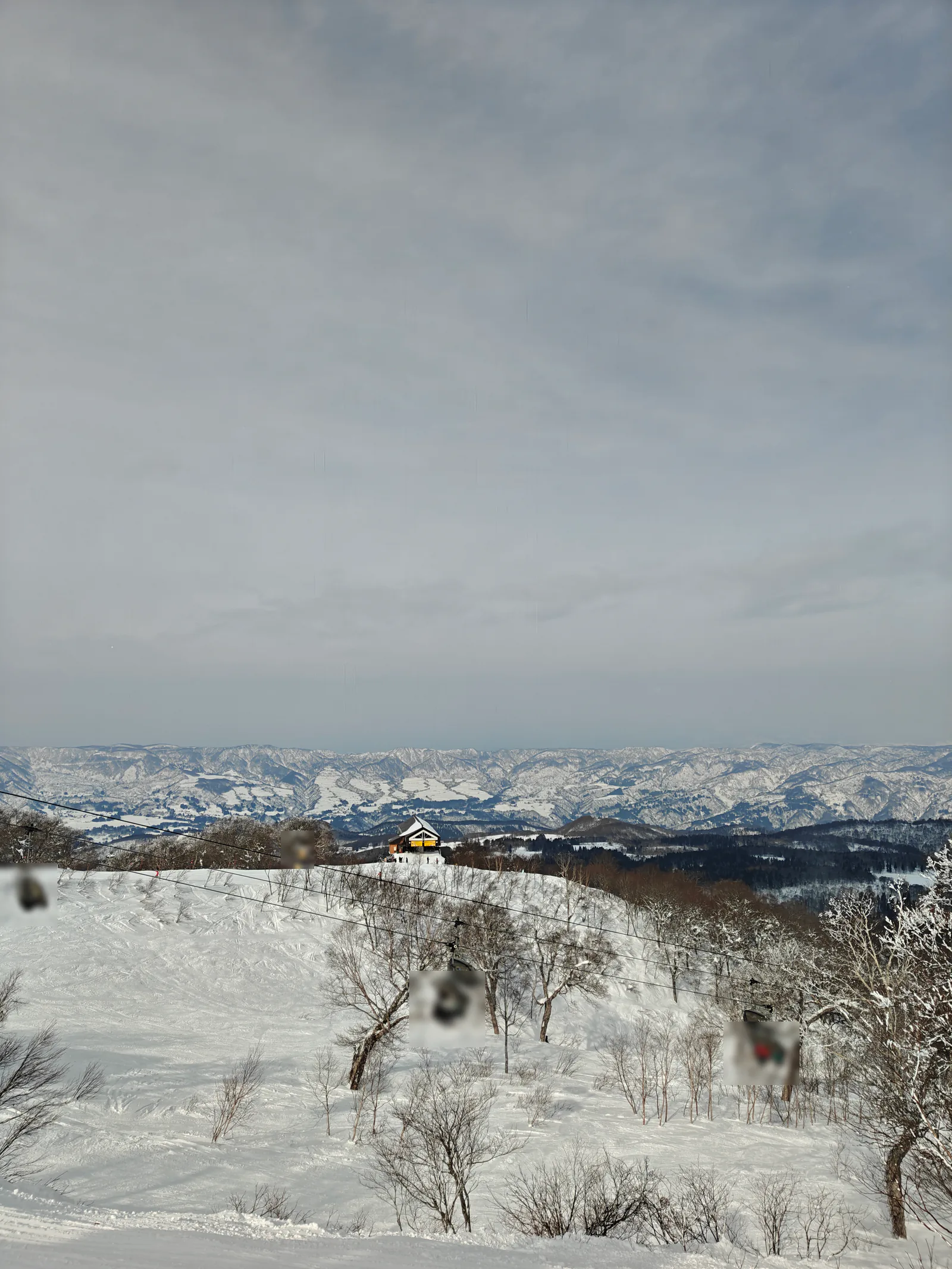
Chairlift seats with riders cross a snowy slope of bare trees toward a small lodge on a ridge, with snow-covered mountains under a grey overcast sky.

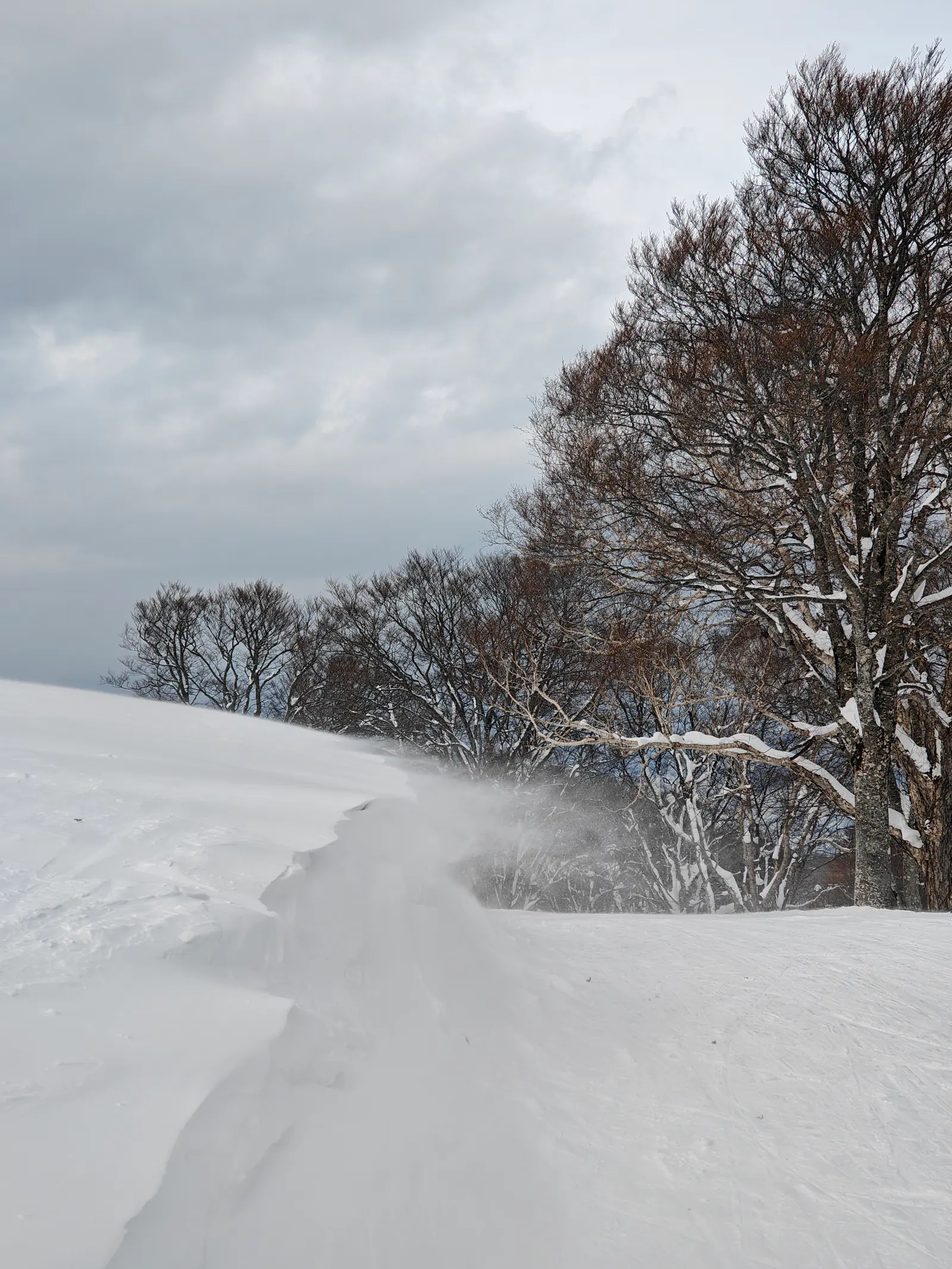
No snow had fallen for around a week before I arrived, but off-piste it felt fresher, and the snow was much better there. Early in the afternoon the wind became stronger and stronger, and it felt extremely cold, especially because I didn't have proper gear: I had decided not to rent a ski jacket, so I just had a soft-shell.

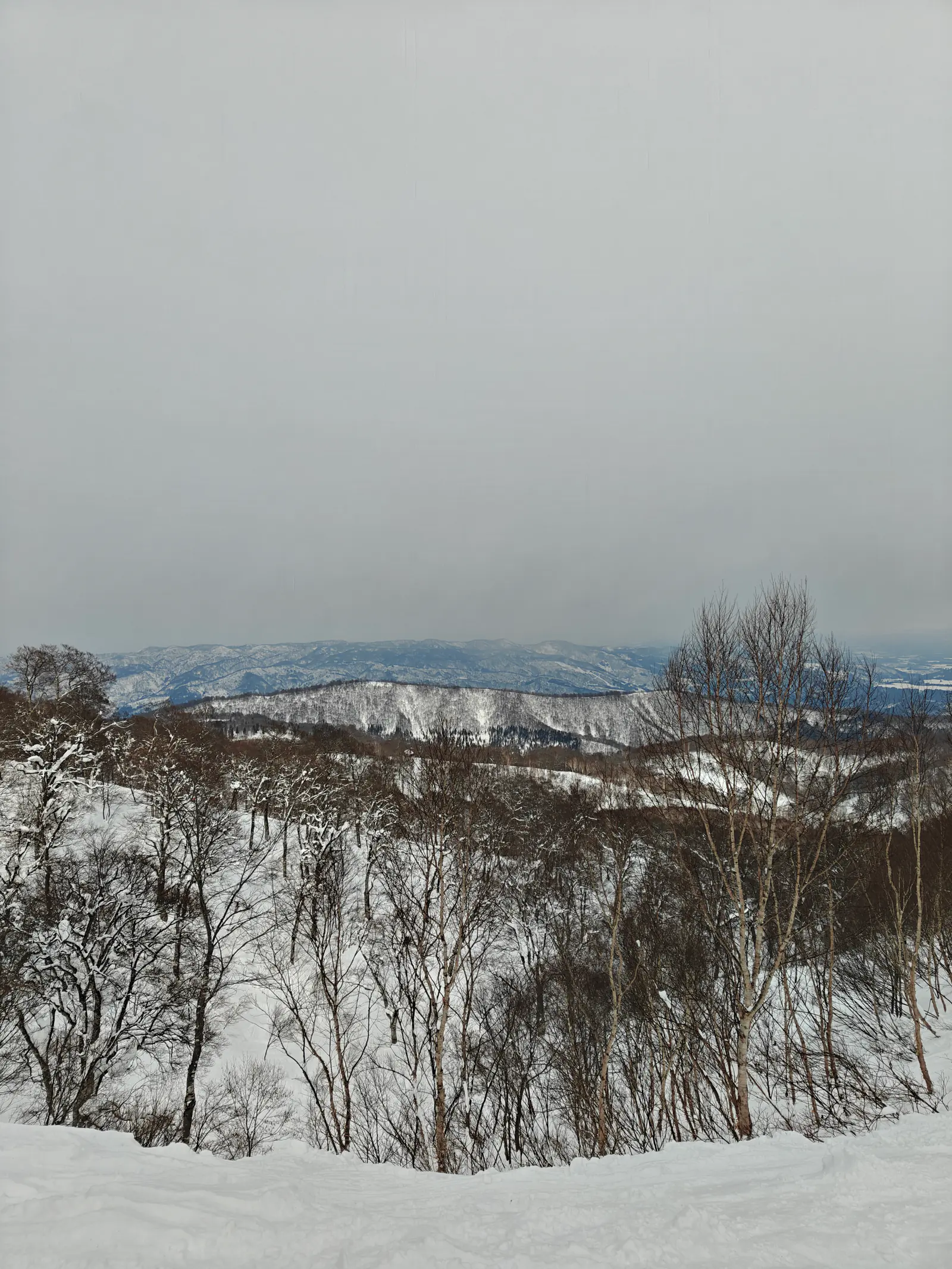
Snow-covered slope of bare birch trees looking out over layered white mountain ridges under a flat grey sky.
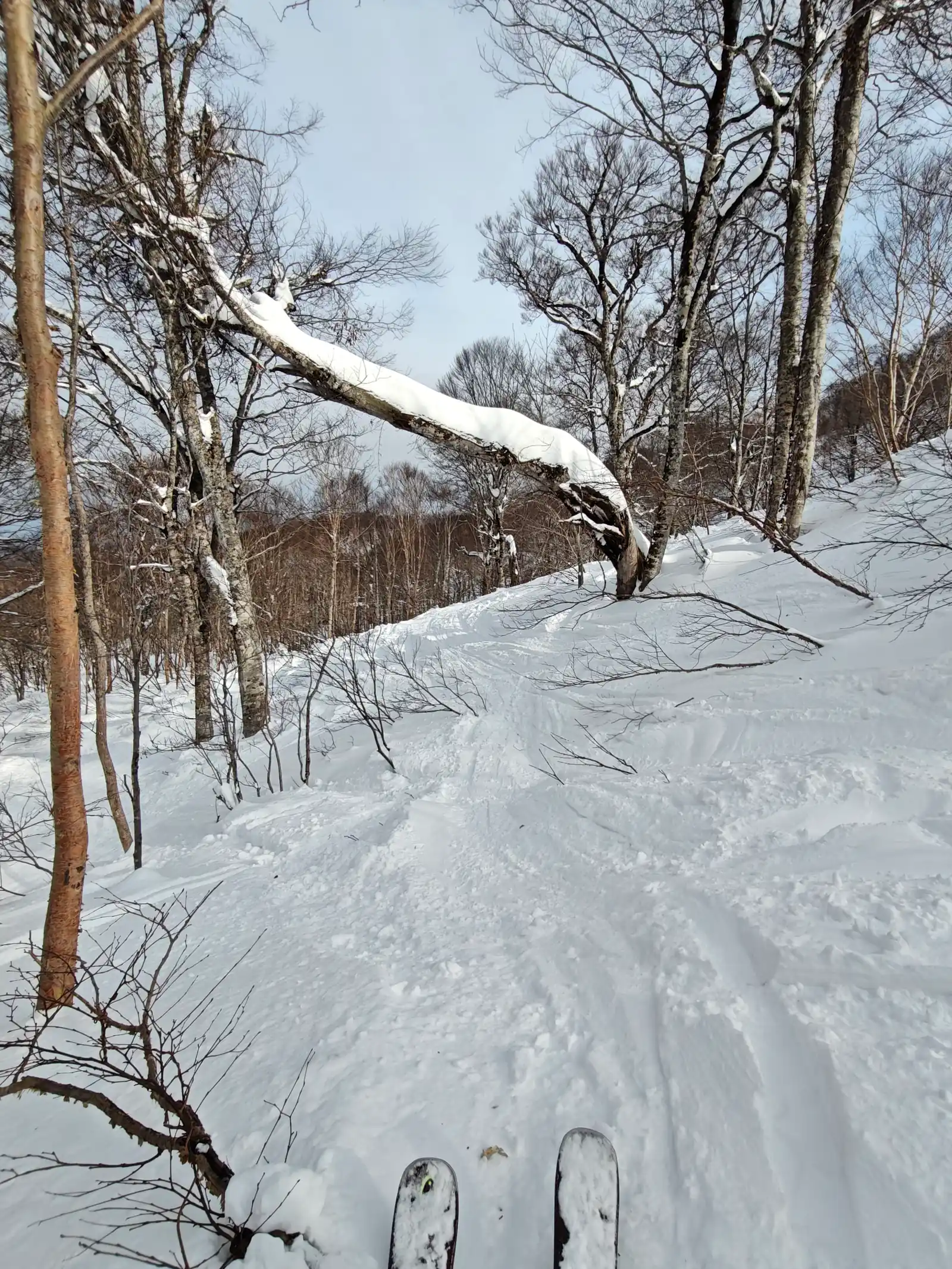
Ski tips at the bottom of the frame point down a tracked snowy path through birch woods, with a snow-laden trunk bending low across the way.

On the main slopes, around the highest parts of the resort, black ice started appearing as the wind picked up, and this is the reason why I mostly skied off-piste.

Wind whips powder off the edge of a snow cornice beside a row of large bare trees under a grey cloudy sky.
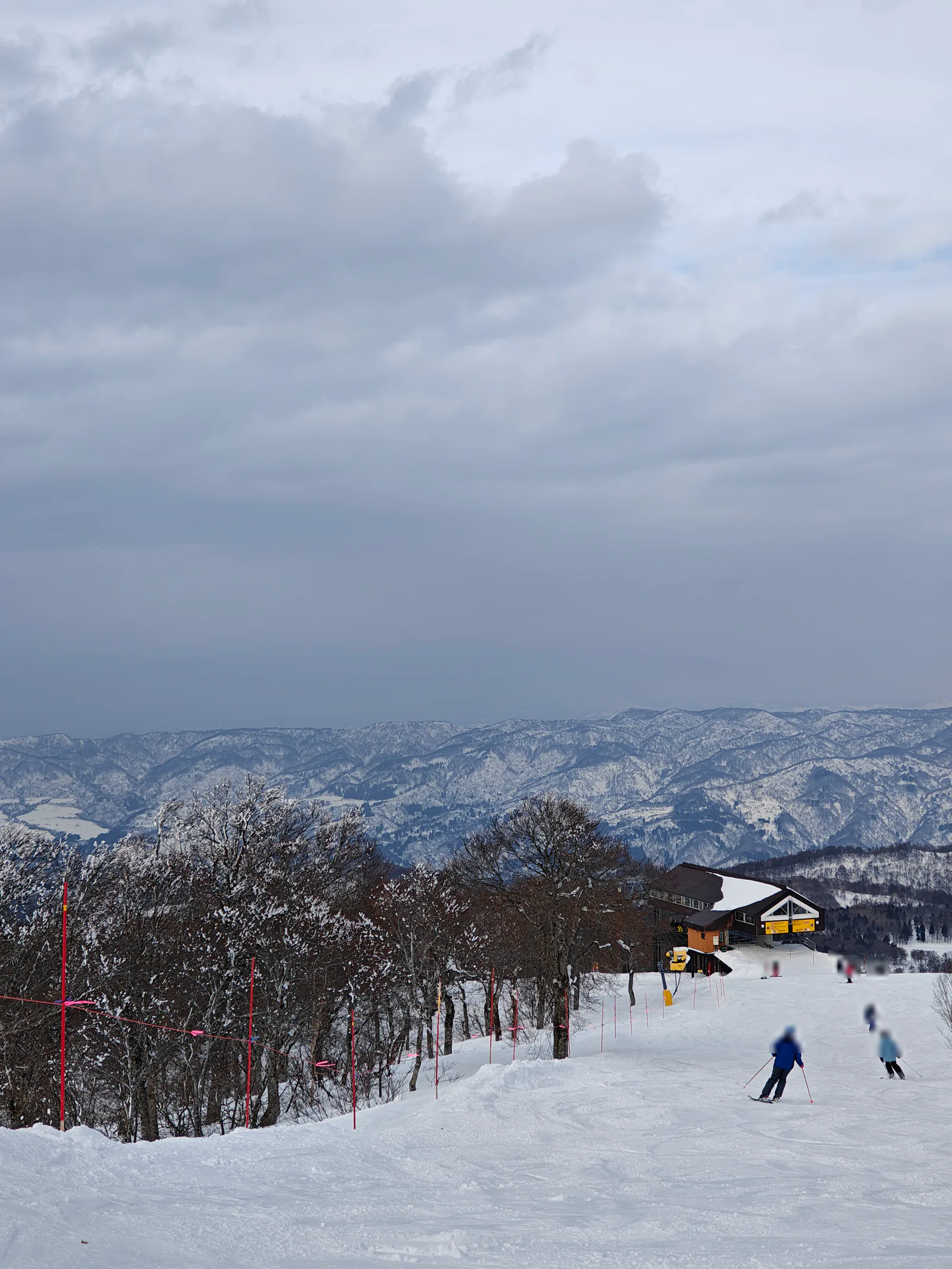
Skiers descend a groomed slope past a wooden lift building and pink boundary poles, with snowy mountain ranges under heavy grey clouds beyond.

So in January, rent a proper ski jacket with the rest of your gear. And when the wind brings black ice to the top of the main slopes, head off-piste.

Renting everything the day before

Since I had booked my two nights here just a few days before, I hadn't prepared anything, and I had absolutely no ski gear. Fortunately, it's possible to rent absolutely everything without any problem.

I rented at a shop named SRS野沢のざわカワヒロ長坂ながさか店てん (SRS Nozawa Kawahiro Rental), right next to the Nagasaka gondola station. I booked it online the day before, and the QR code I got was all I had to show at the counter. So I didn't even have to explain what I needed in Japanese (well, actually, the staff spoke English surprisingly well). Booking the rental and the pass on my phone was insanely convenient. The lockers at the top of the gondola were handy too: I had some issue with my helmet, and I could just leave it there while I was skiing.

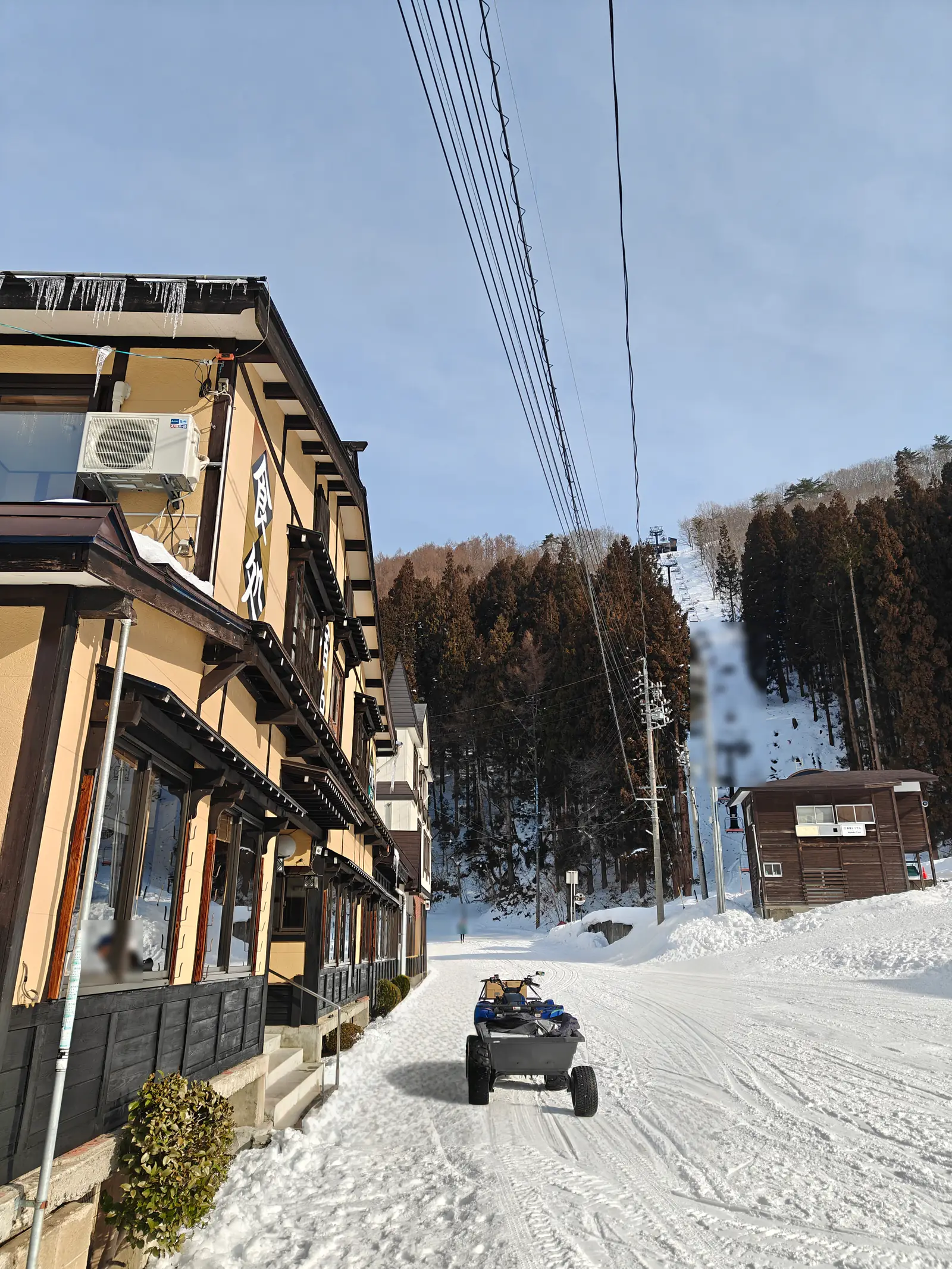
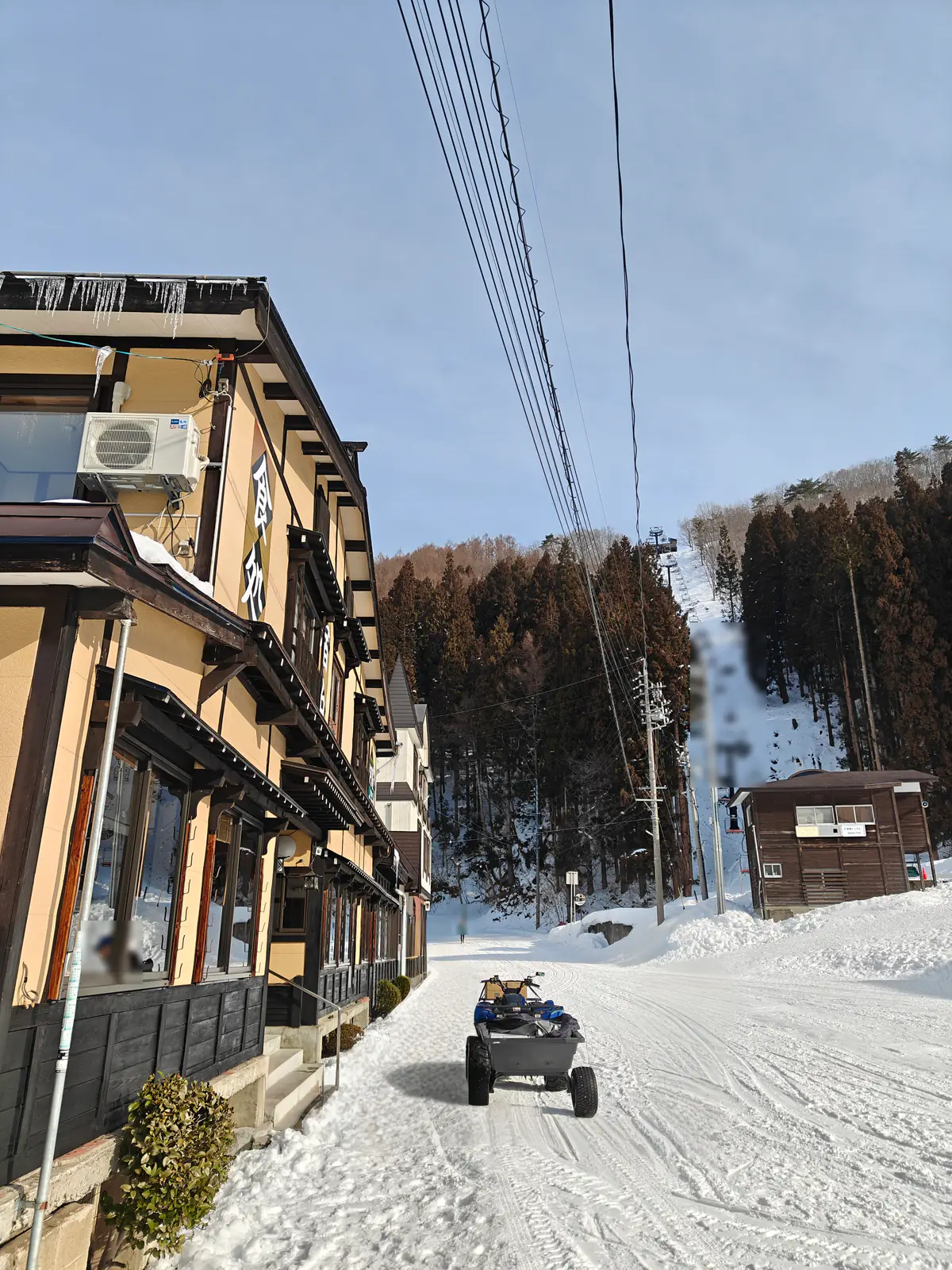
A snowy road runs past a cream and dark wood building with icicles toward a chairlift climbing a cedar-covered slope, with a quad bike and trailer parked on the snow.
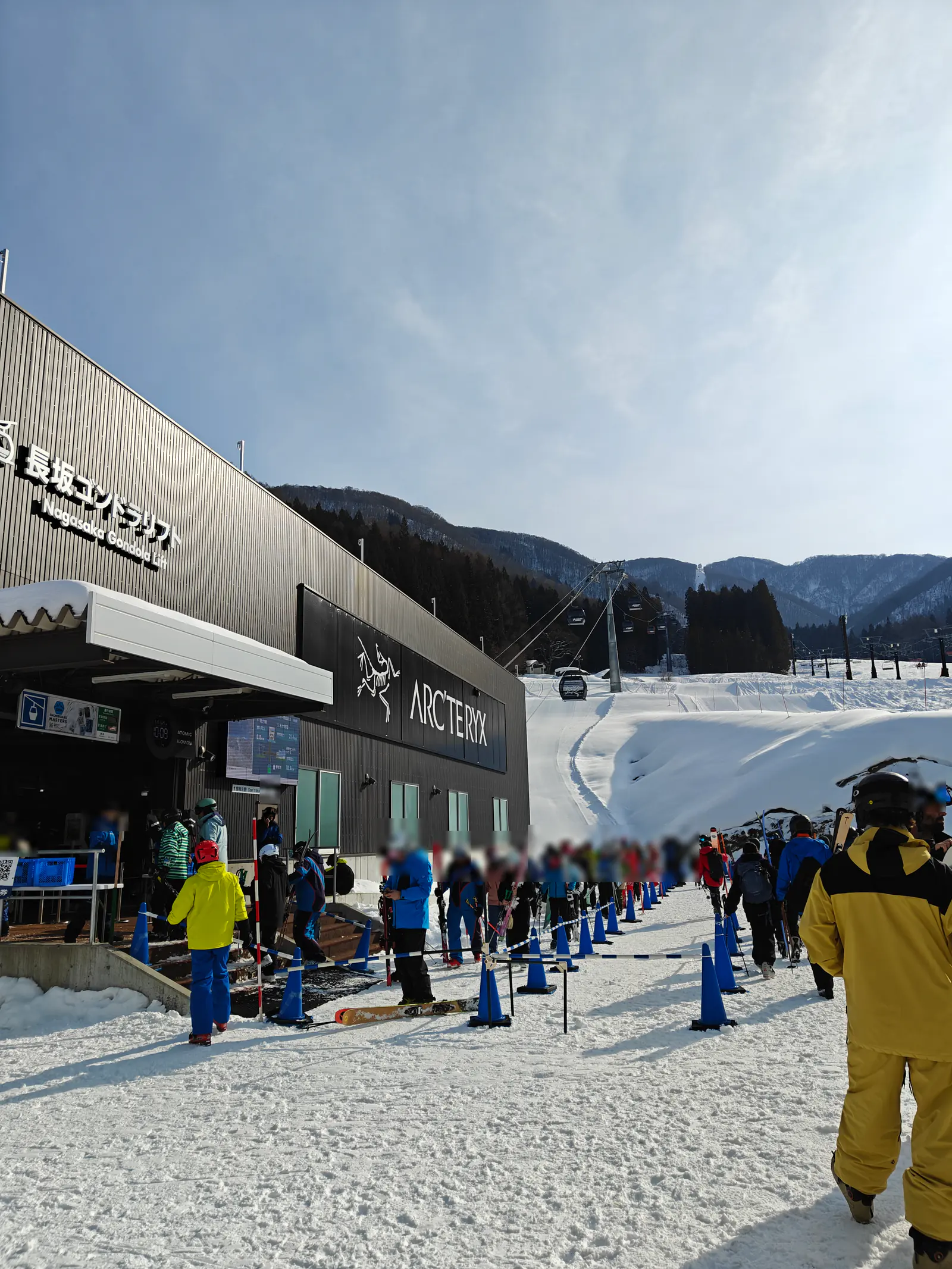
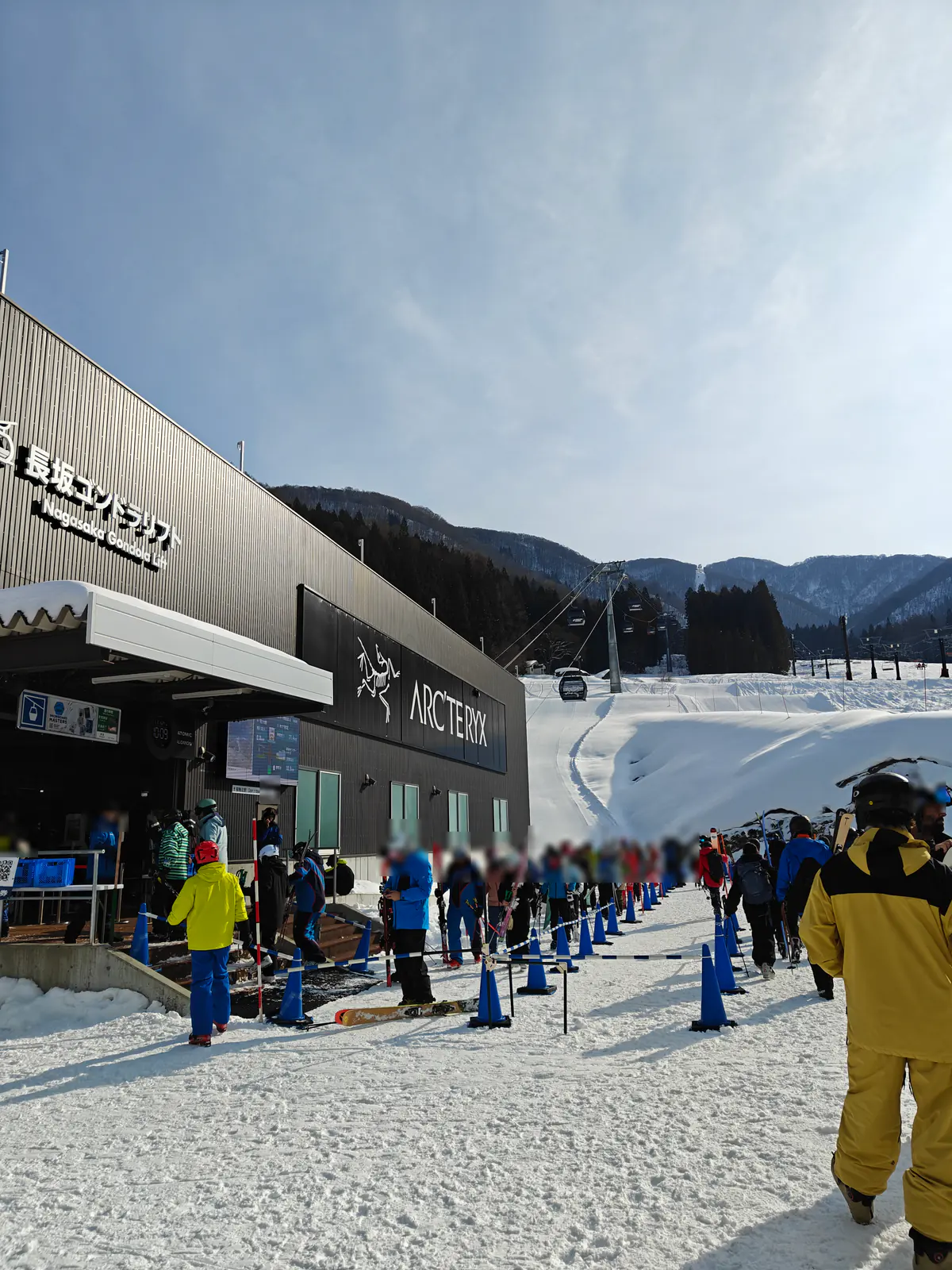
Skiers and snowboarders queue between blue cones outside a dark gondola station building, with gondola cabins climbing a snowy slope toward forested mountains under a blue sky.
This is the Nagasaka gondola: two of its 80 ten-seat cabins have see-through floors.

The Dōsojin fire festival, in short

The 道祖神どうそじん (dōsojin) are the gods of the village's borders and crossroads: they keep danger out, and people pray to them for children and a good marriage. Their festival in Nozawa is held every 15 January, it has been a national Important Intangible Folk Cultural Property since 1993, and it's often called one of Japan's three great fire festivals.

In one line: the men in their 厄年やくどし (yakudoshi, unlucky year) defend a wooden shrine built new every year, the other men of the village try to set it on fire, and visitors only watch.

Since 2023, you can only get in with a ticket, and only village residents and guests staying in the village get one. No drinks may be brought in.

My inn gave me the entry ticket, and I was there from 7pm to the end. I was so hyped for this matsuri, and it genuinely didn't disappoint: the "fight" between the two groups at its peak at the end, then the entire wooden shrine burning until there's nothing left. It's my 4.5 for wow factor, when the town itself gets a 3.

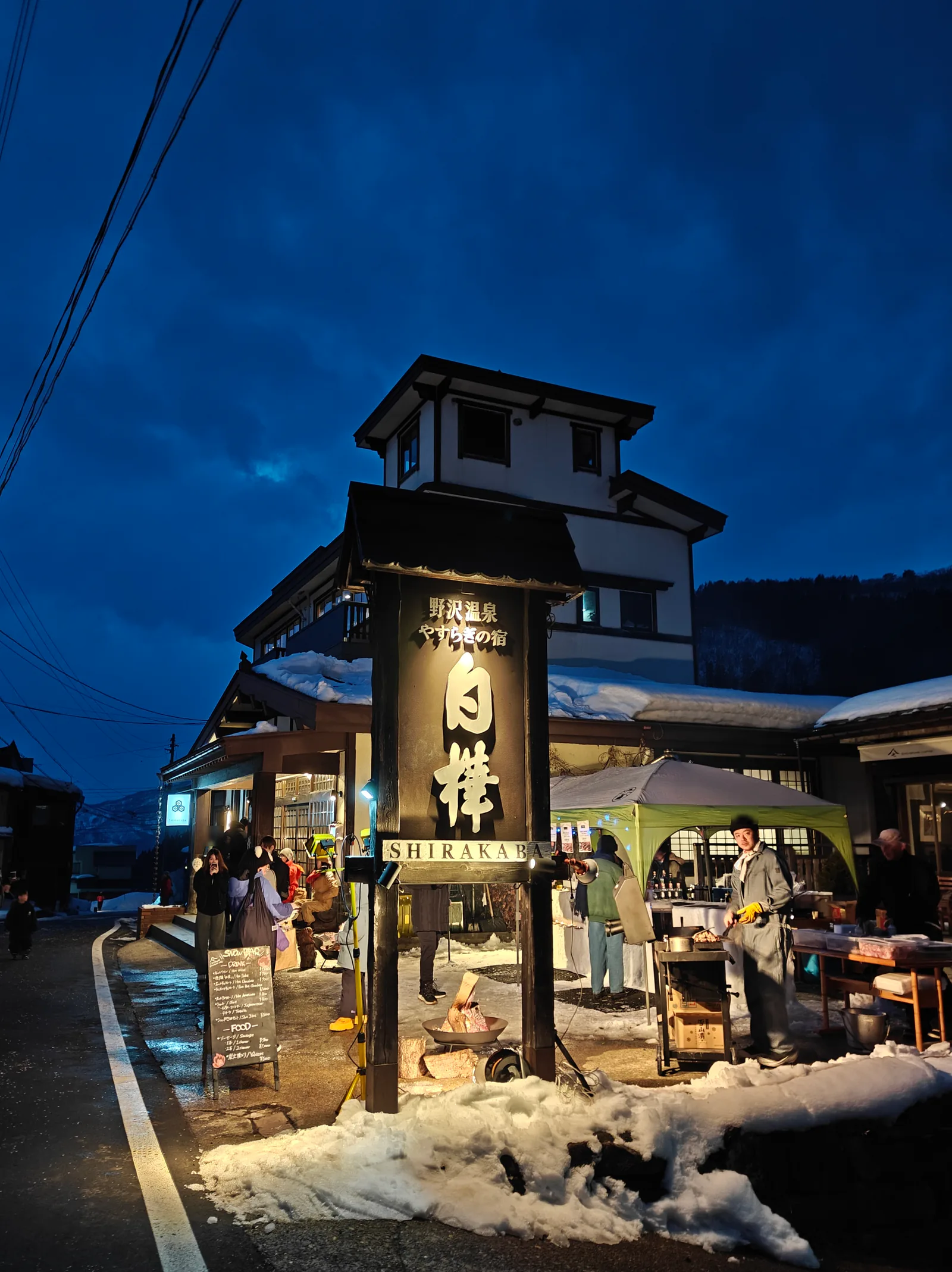
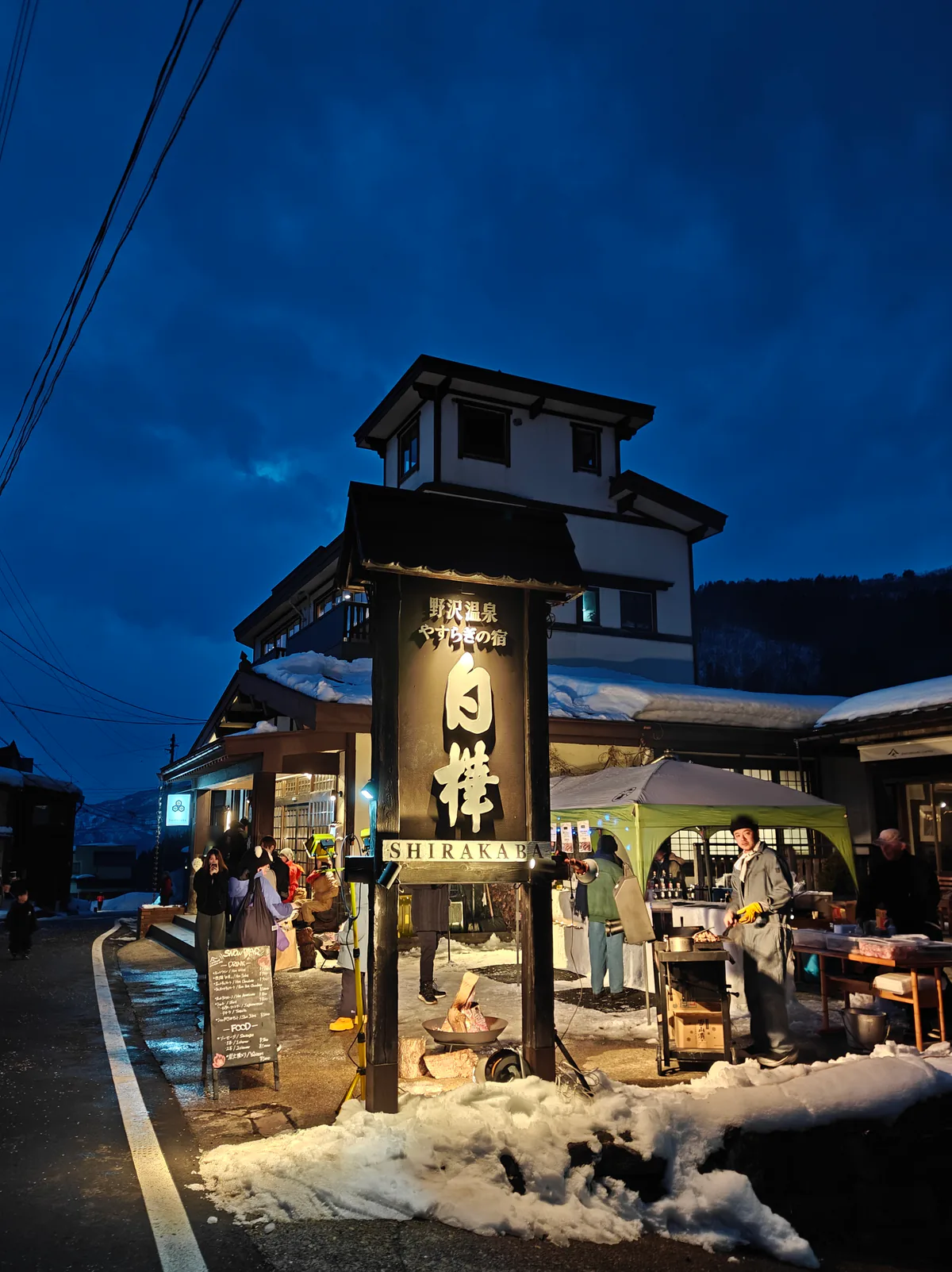
At dusk a lit wooden sign stands outside a snowy inn, where people gather around an outdoor grill, a drinks tent and a chalkboard menu.

So stay in the village that night, since the ticket comes with your stay, and book several weeks early: closer to the day, everything is full and prices get much, much higher.

A lively village, and a foreign bubble

When I was wandering around to find somewhere to eat, I discovered that a lot of the people working in town, and the tourists, are actually foreigners, mostly from Australia, New Zealand and the United States.

The figures say the same. In 2024, Australians were 44.5% of Nozawa's foreign visitors, the highest share of any Nagano municipality in the prefecture's report, and foreigners are about 30% of the village's overnight guests. Foreigners also run minshuku and restaurants here, and some have even joined the villagers' self-governing body.

This is great to have fun in bars, and very convenient if you don't speak Japanese, but if it's a more traditional Japanese onsen town you're after, this is not really it. The vibe is genuinely lively tho, and enjoyable for hanging out and meeting people.

Not every villager is happy

In a 2025 survey of residents, 58.2% were unhappy with visitors' manners, and the village made etiquette videos, one of them called "Quiet Nights, Please".

I didn't find anything genuinely special to eat here. I went to 元気げんきバーガー (Genki Burger), which was alright, but quite some wait even outside peak hours, as I was there on the day of the matsuri, the most crowded time of the year. There was also some manju at a small shop (I love manju), and some sukiyaki on the second day, before the matsuri began.

I stayed in two minshuku. The first night was at サンライズ明治屋めいじや (Sunrise Meiji-ya), and the second at げんたろう屋や (Gentarōya), a minshuku whose full name calls it 自家じか源泉げんせんの宿やど (an inn with its own spring source), and I bathed in its spring too. げんたろう屋や is really well located.

The crowds were the festival's tho. It was the most crowded time of the year, so I assume it's not always that crowded.

So keep your voice down in the lanes at night, and on a busy night, expect a queue for dinner.

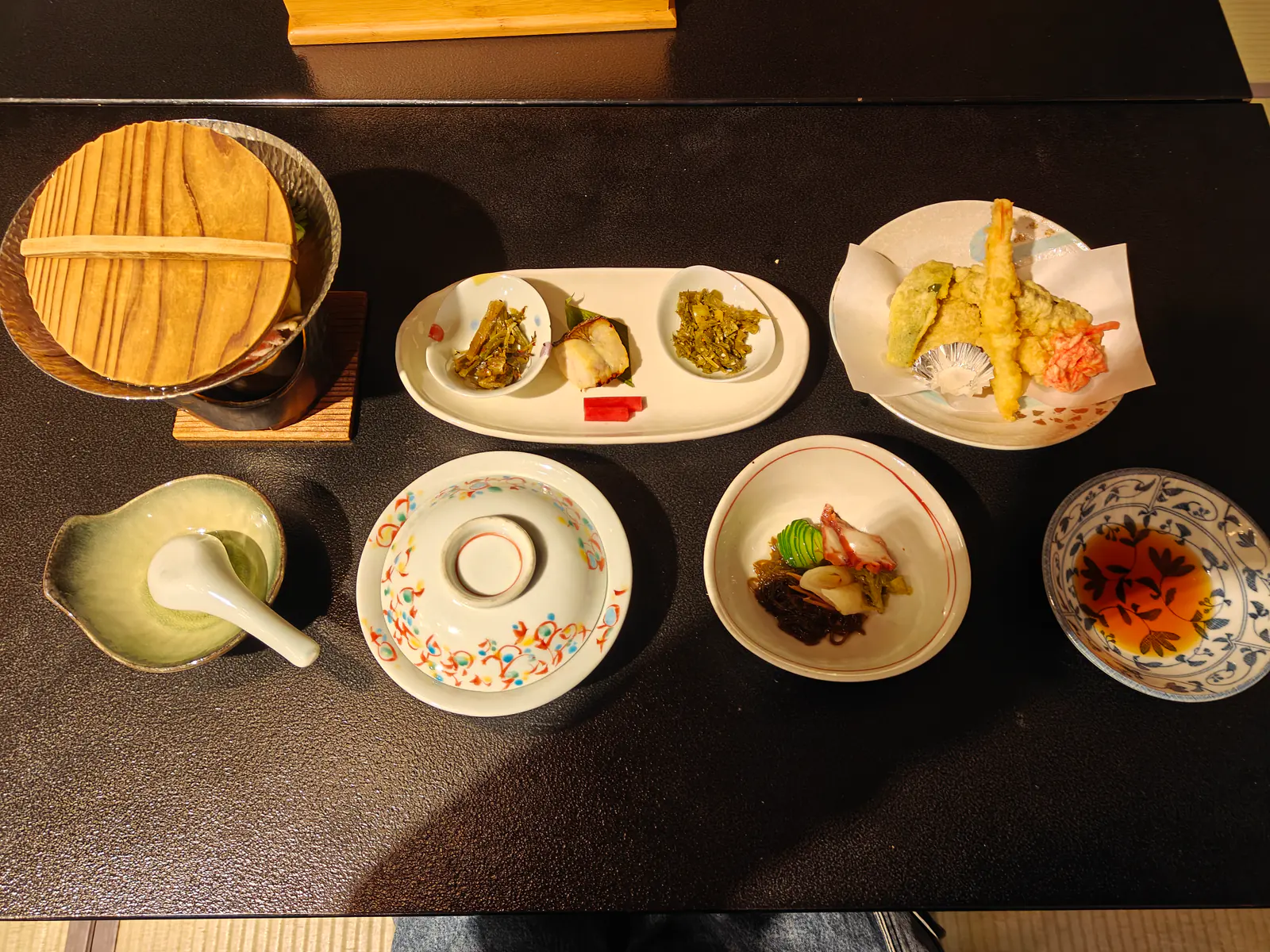
Overhead view of a set dinner on a black table: a lidded wooden pot, small side dishes, tempura, a lidded porcelain bowl, a dressed salad and dipping sauce.
The sukiyaki is under the wooden lid, with tempura on the side.
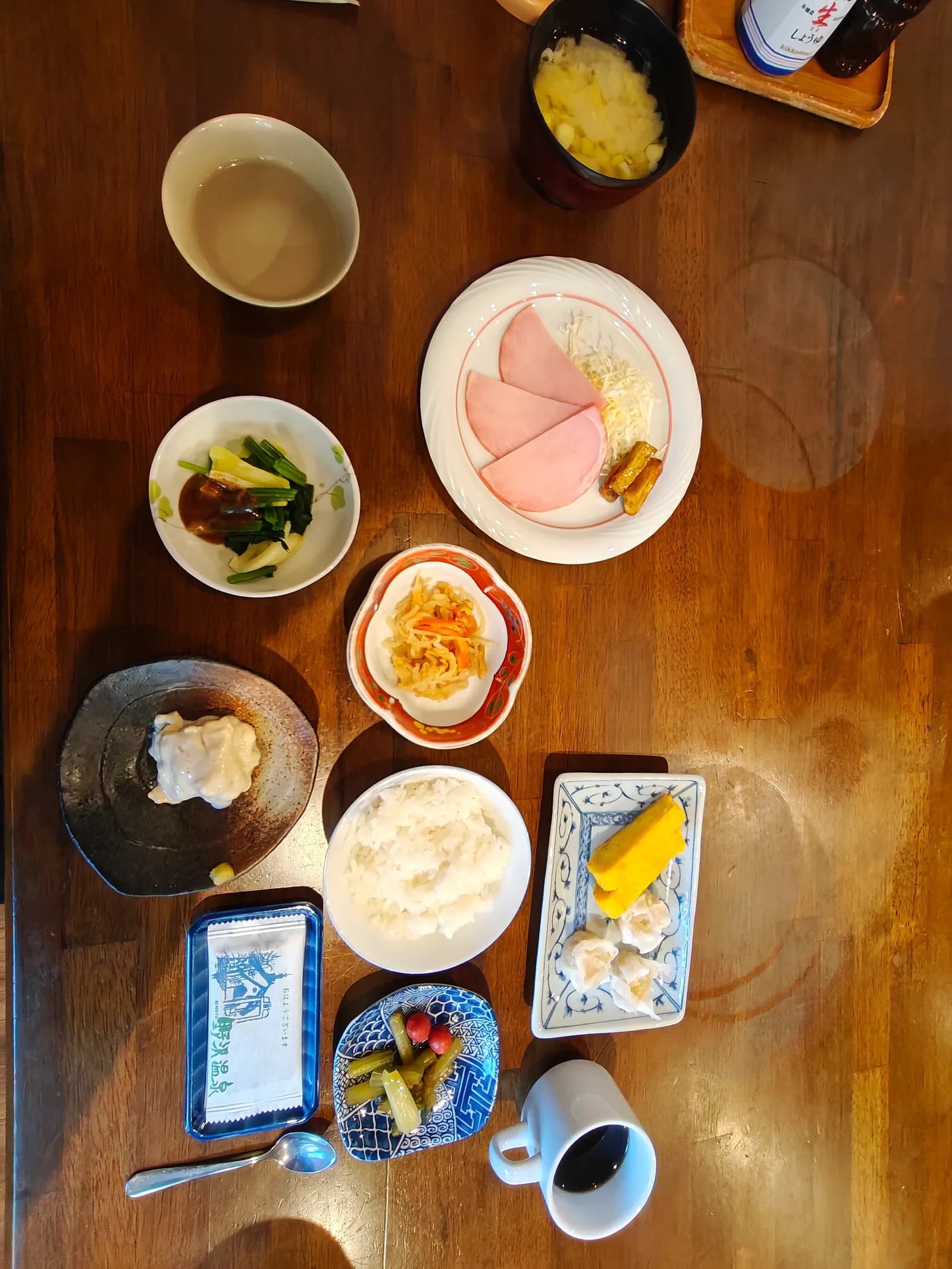
An overhead view of a breakfast spread on a wooden table: rice, soup, ham slices, rolled omelette with dumplings, pickles, small side dishes, coffee and a wrapped towel.
Breakfast at サンライズ明治屋めいじや (Sunrise Meiji-ya), my first minshuku.

Iiyama, on the way home

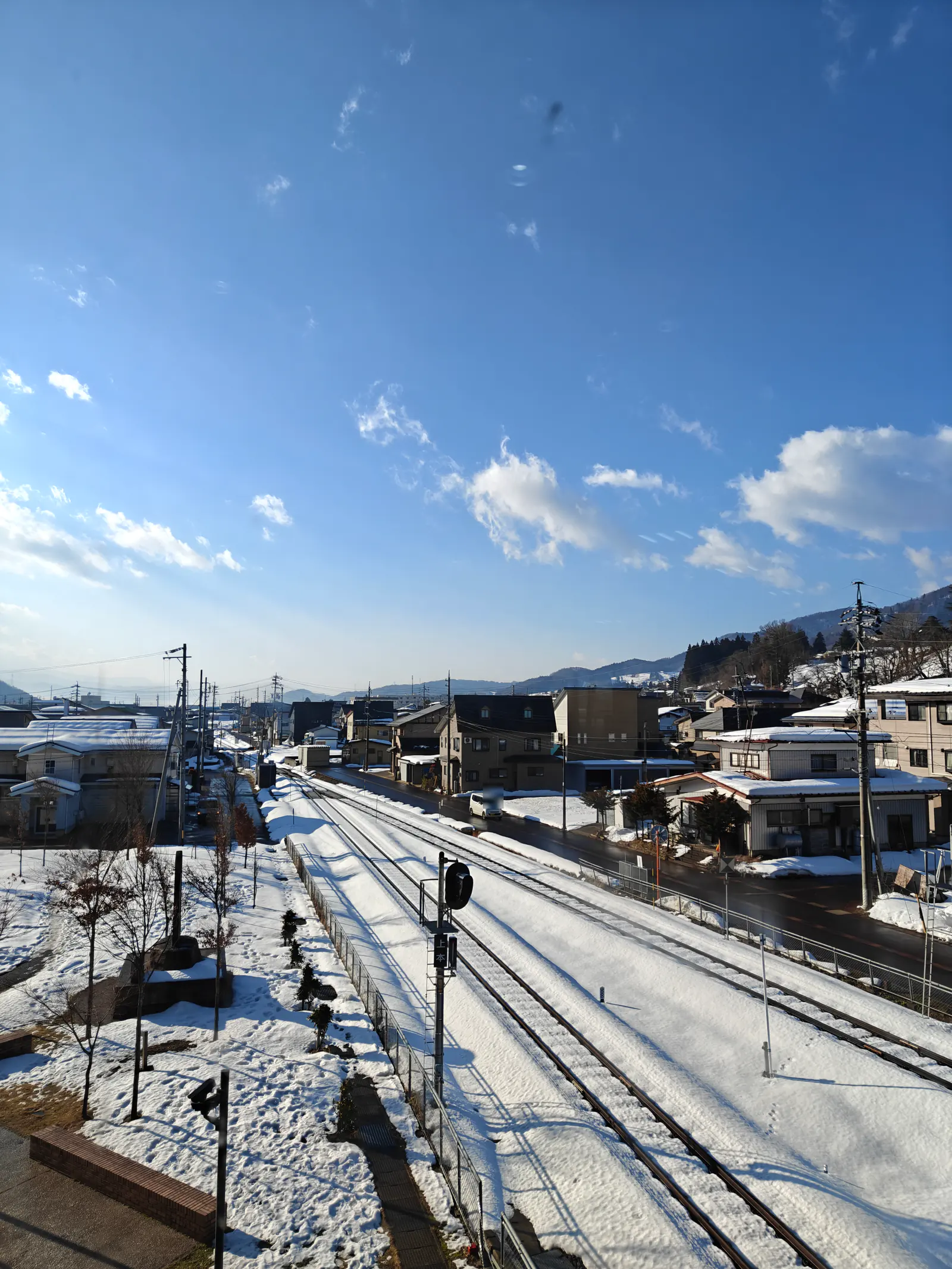
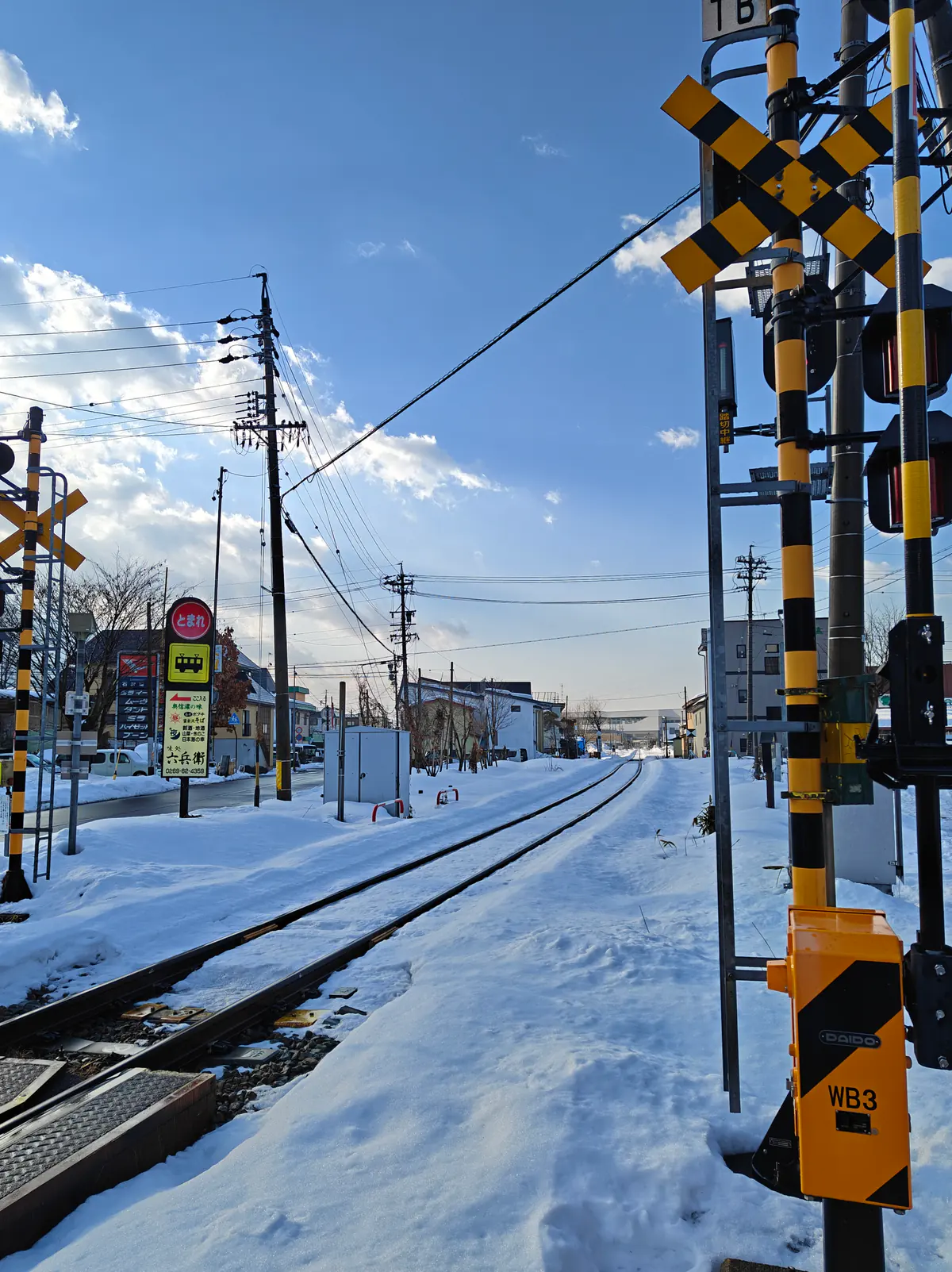
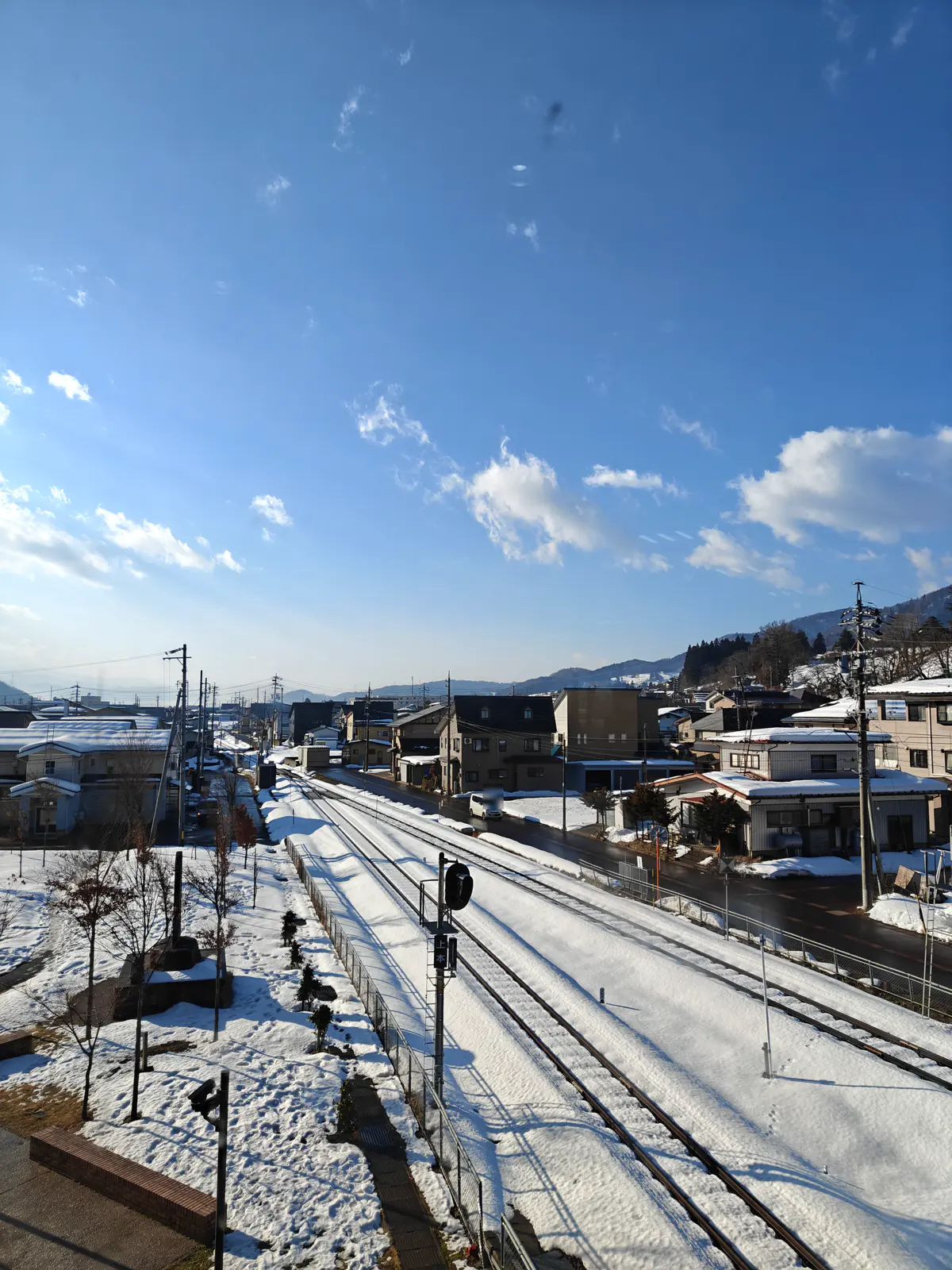
When there's snow, Iiyama is genuinely a beautiful quick stroll. I spent 30 minutes wandering around the town while I was waiting for my Shinkansen, and it's a highlight of the trip.

Iiyama is also where you change for Nozawa. The bus to the village leaves from its station and takes about 25 minutes. Another station carries Nozawa Onsen in its name, yet no public transport runs from it to the village, so don't get off there.

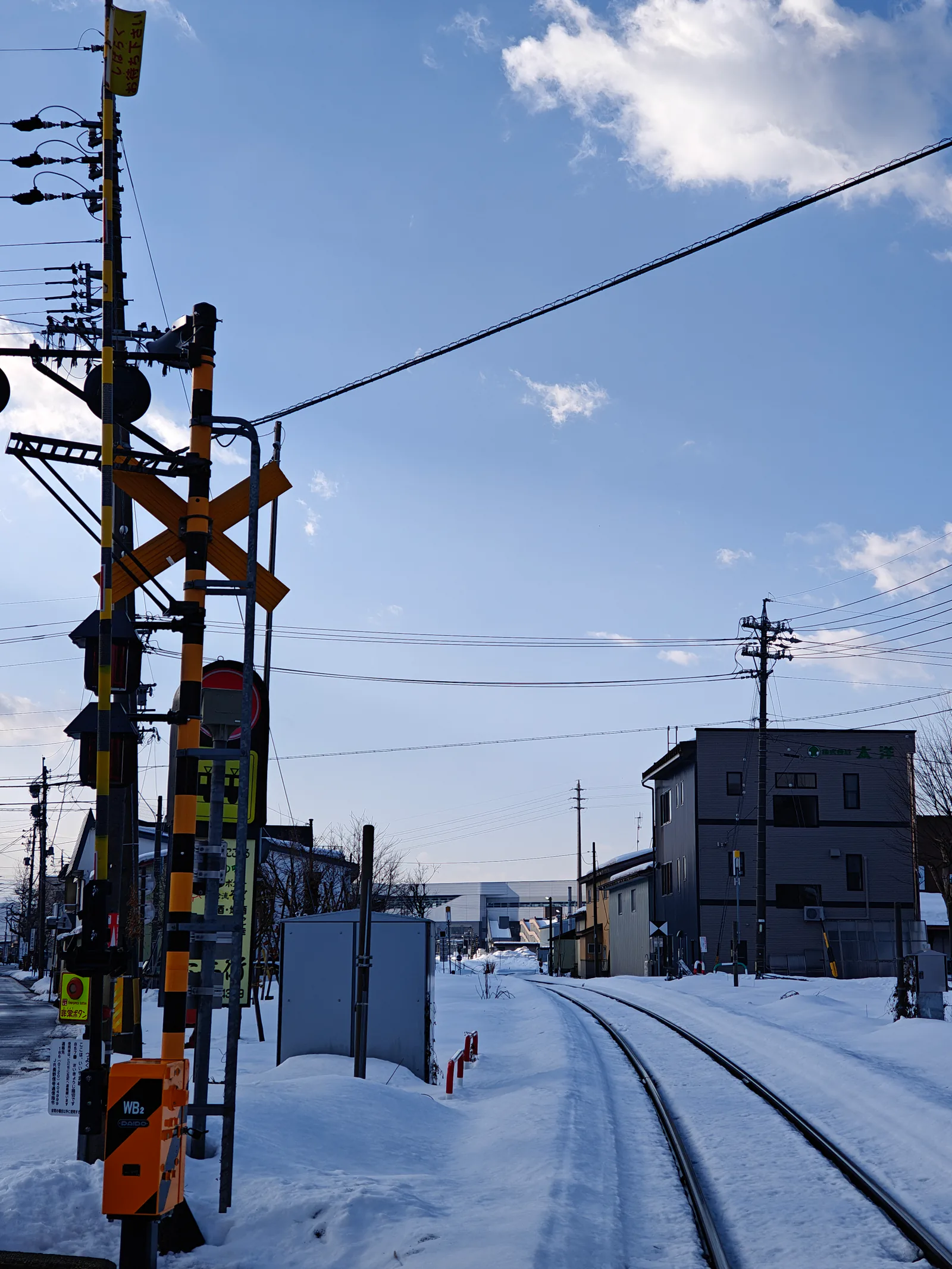
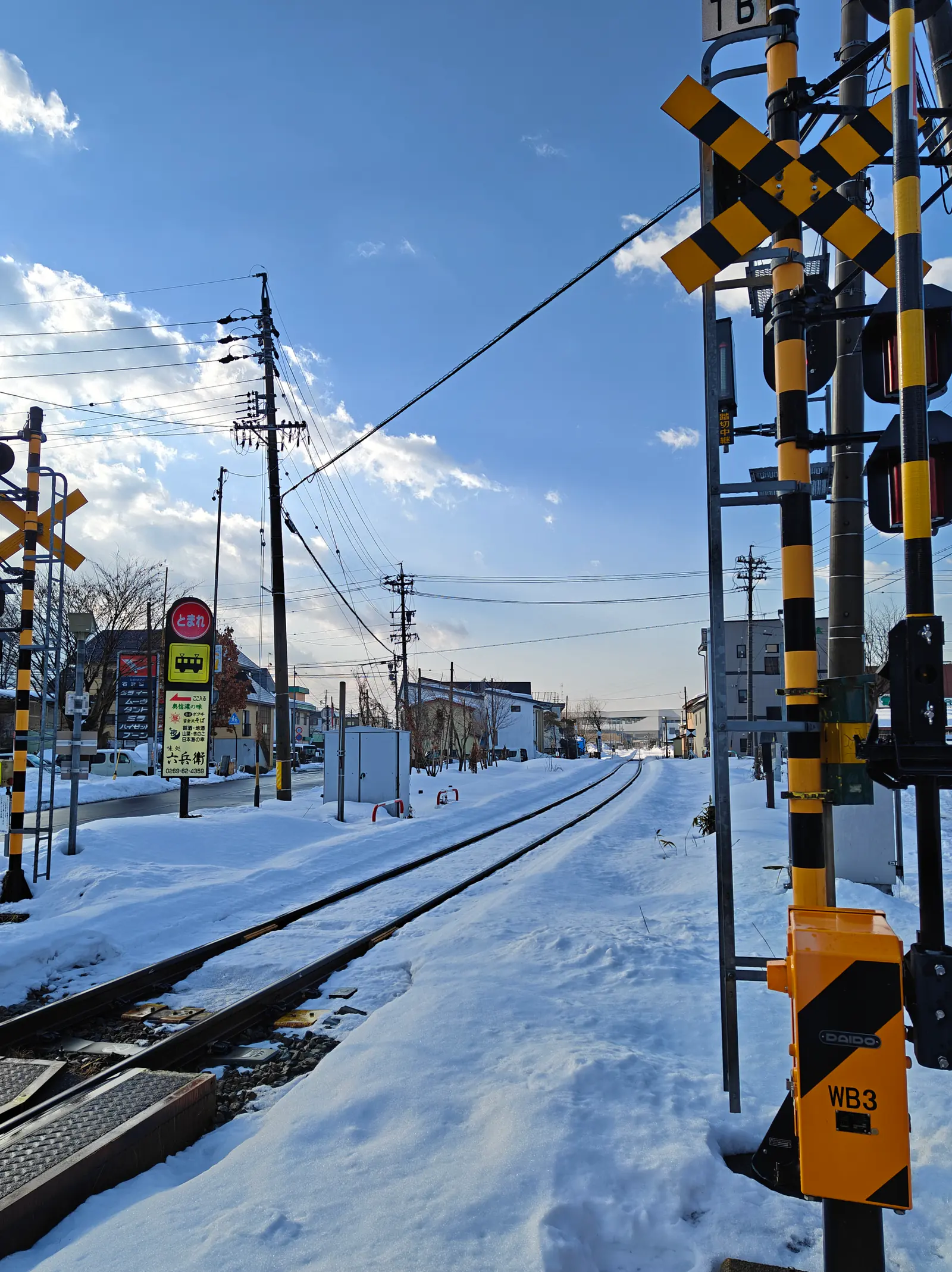
A single snow-covered railway track runs straight into the distance from a yellow-and-black level crossing, with utility poles, low buildings and roadside signs under a blue sky.
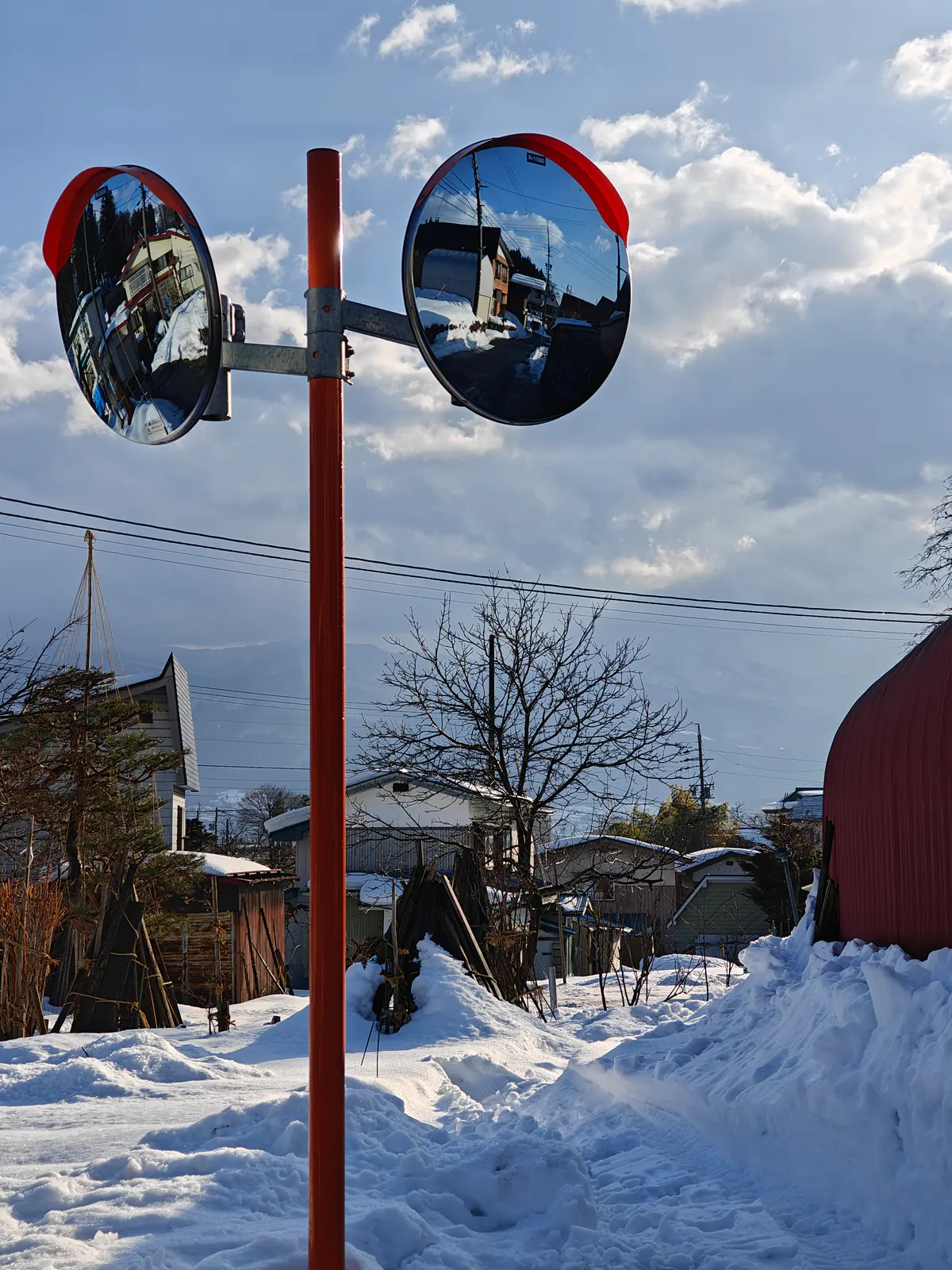
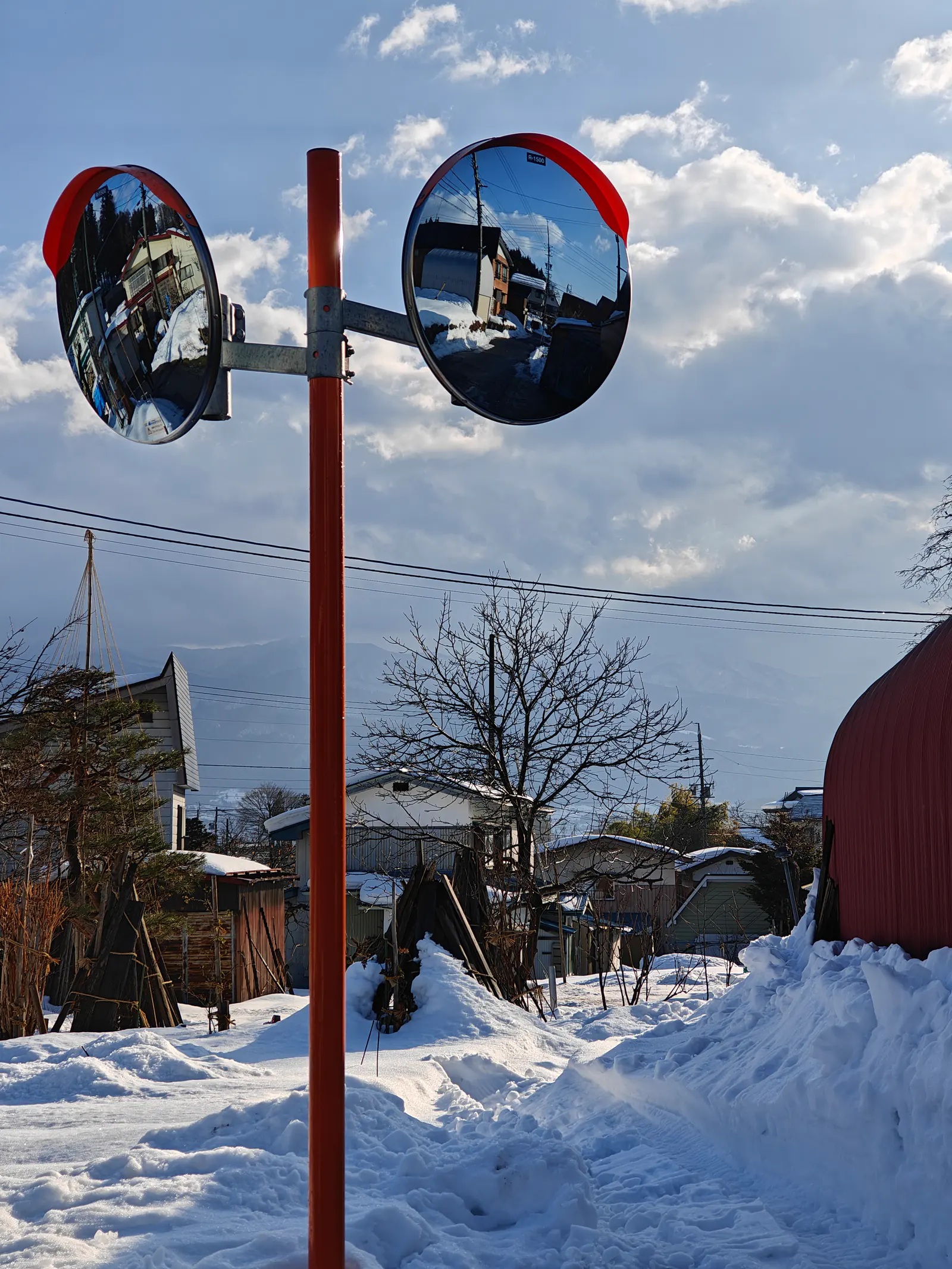
Two round convex road mirrors on an orange pole reflect a snowy lane, with houses, bare trees and hazy mountains behind.
Snow-covered railway tracks with a signal run past a road and houses toward low mountains under a wide blue sky, seen from above.

Iiyama is called the little Kyoto of snow country, a name credited to the novelist Shimazaki Tōson, and its temple quarter, laid out in 1583, still holds some twenty temples. It has its own part in the ski story too: in 1912, a teacher at its middle school, who was also a temple priest, first brought skiing to Nagano.

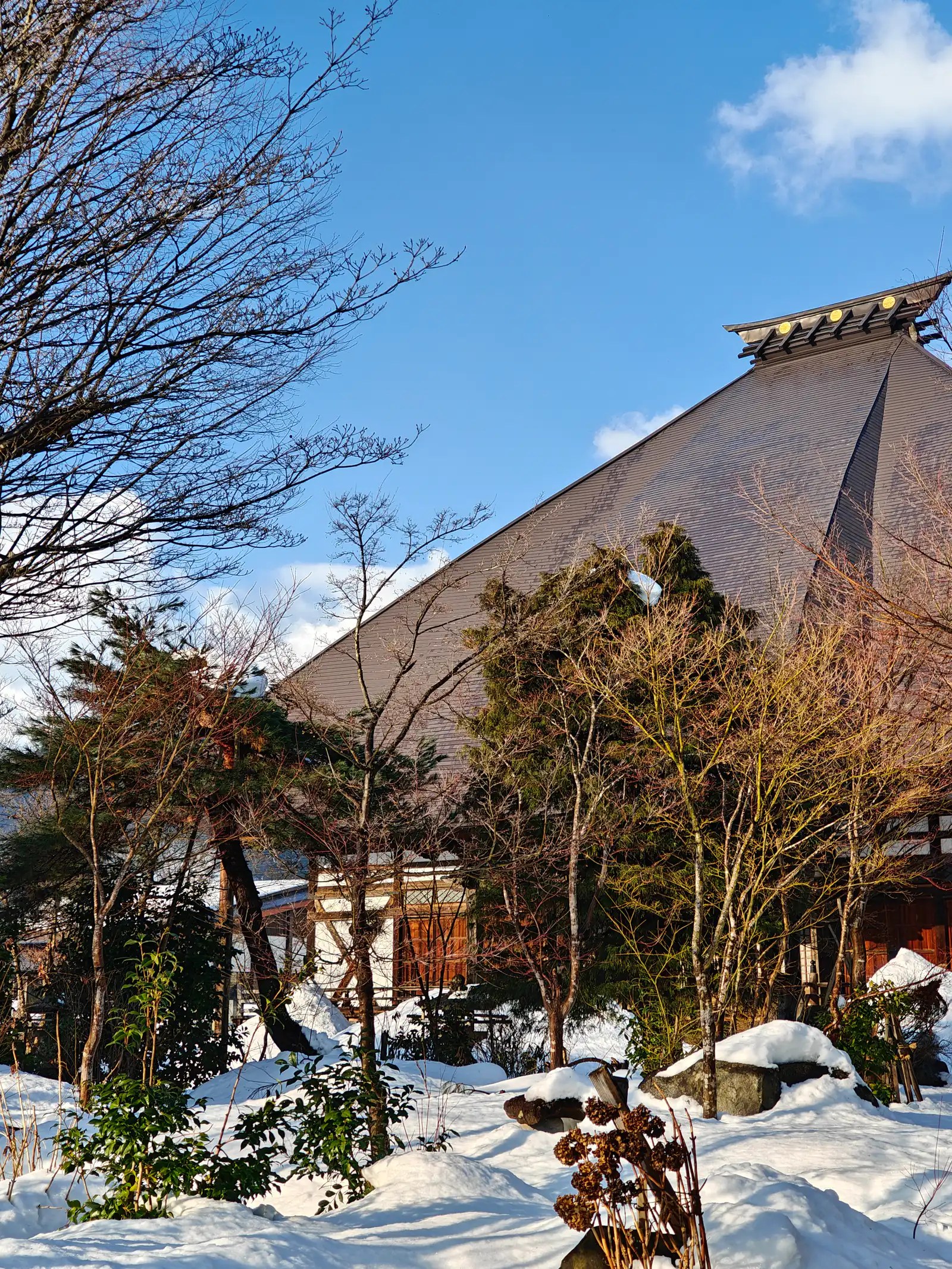
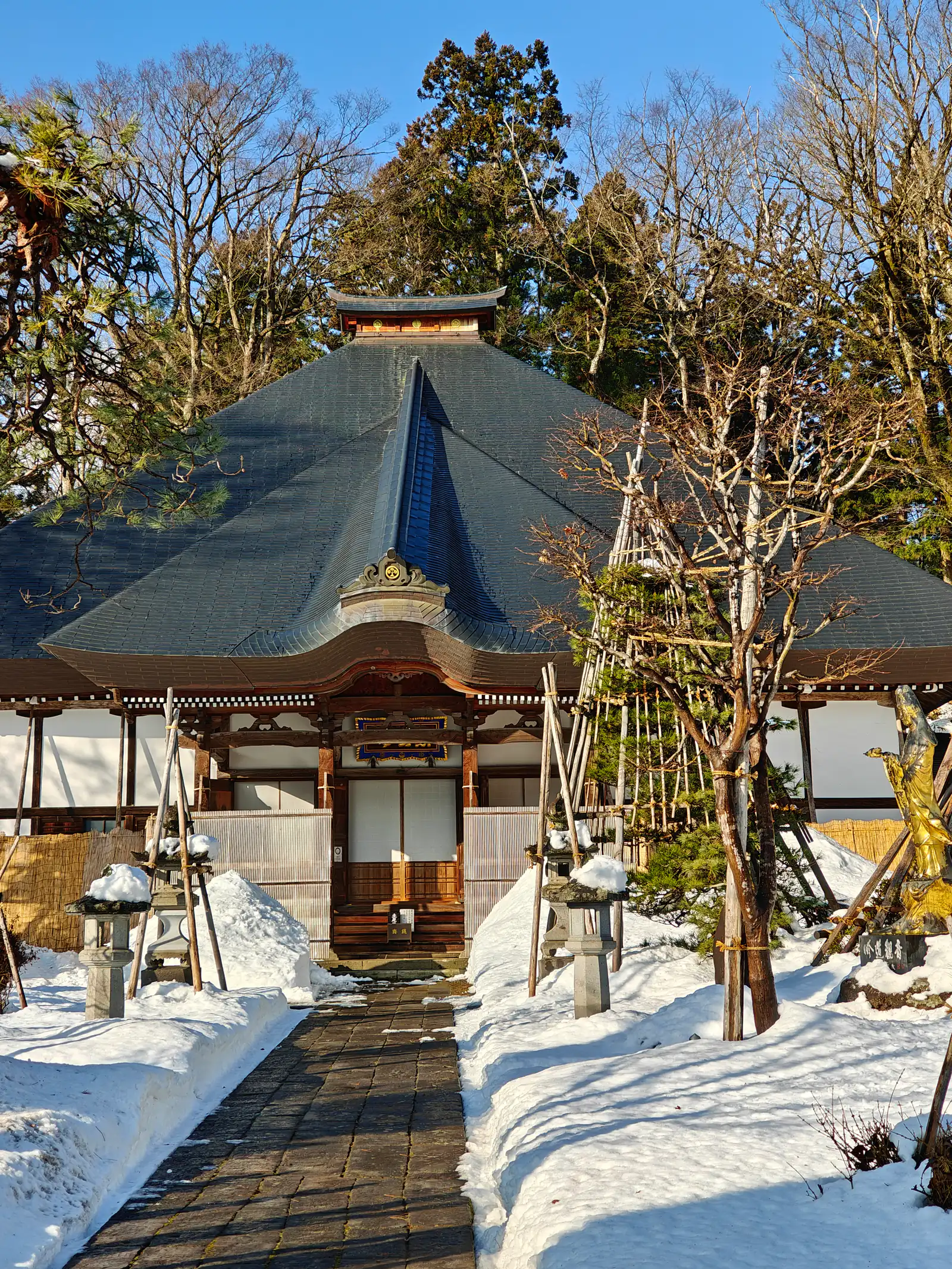
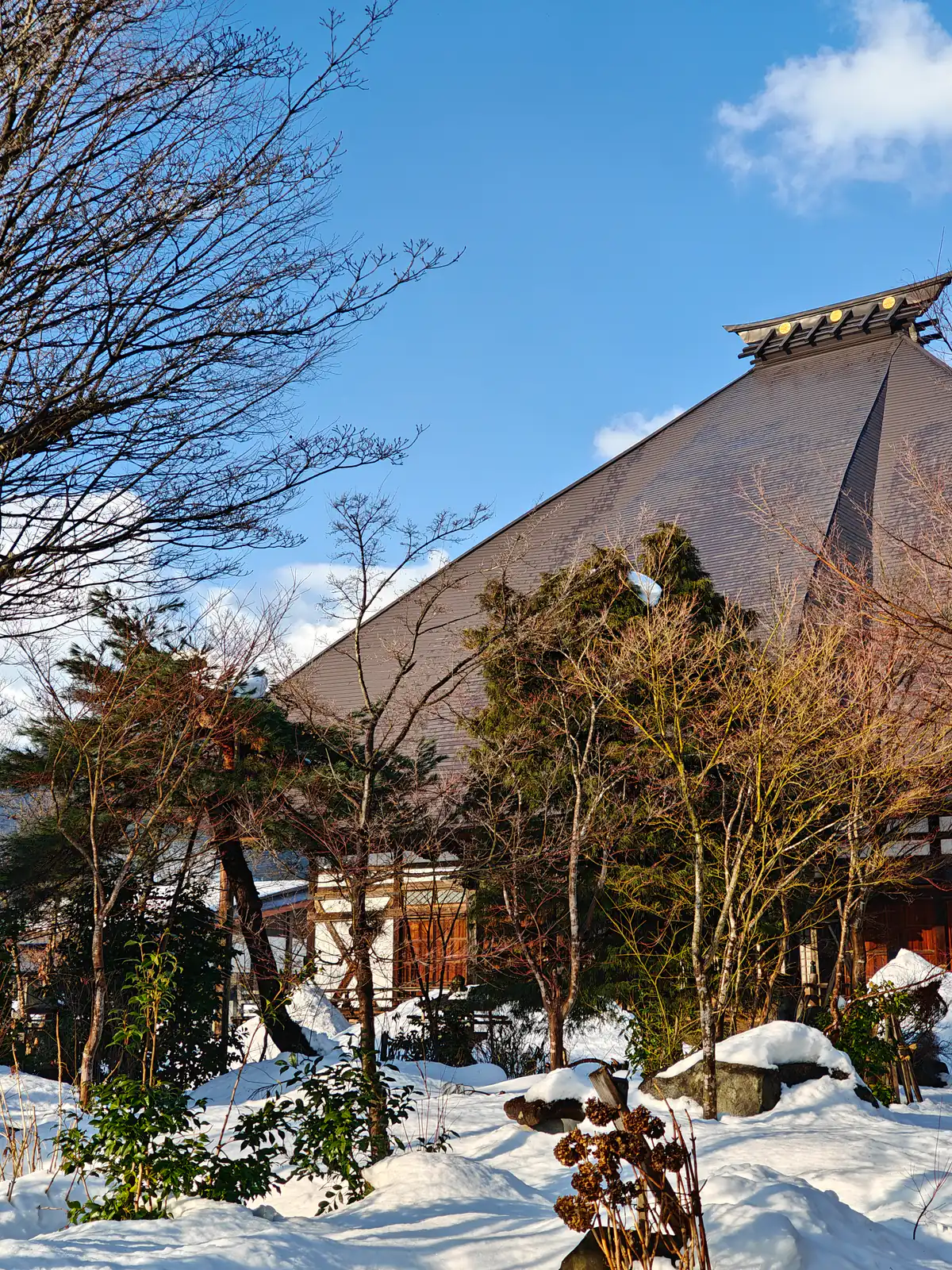
About 10 minutes from the station, in the northern part of the town, there's an area with plenty of temples that are beautiful under the snow, and 称念寺しょうねんじ (Shōnenji) is my favourite. It was founded by a disciple of Shinran, moved here in 1620, burned in 1920 except its gate and bell tower, and was rebuilt in 1968. Its bell rang on NHK's New Year's Eve broadcast in 1981 and 1990.

I even talked for a bit with an old local, who was very surprised to see a foreigner here, as no one leaves the station to explore the town.

So give yourself half an hour before your train, and walk north from the station to the temples.

The steep pyramid roof of a wooden temple hall rises behind bare trees and a snow-covered garden under a blue sky.
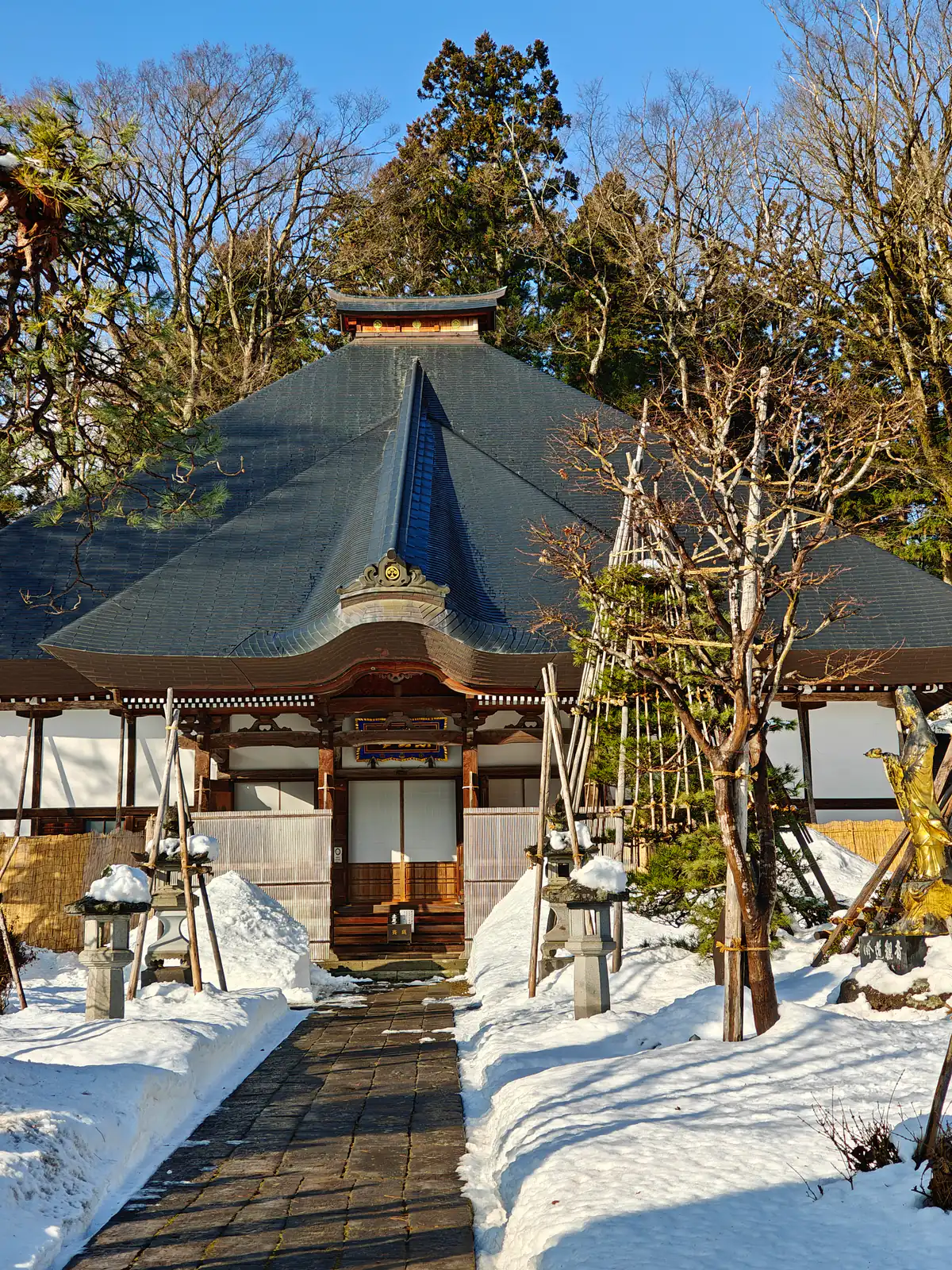
A cleared stone path leads between snowbanks and capped stone lanterns to the entrance of a temple hall with a sweeping dark roof.
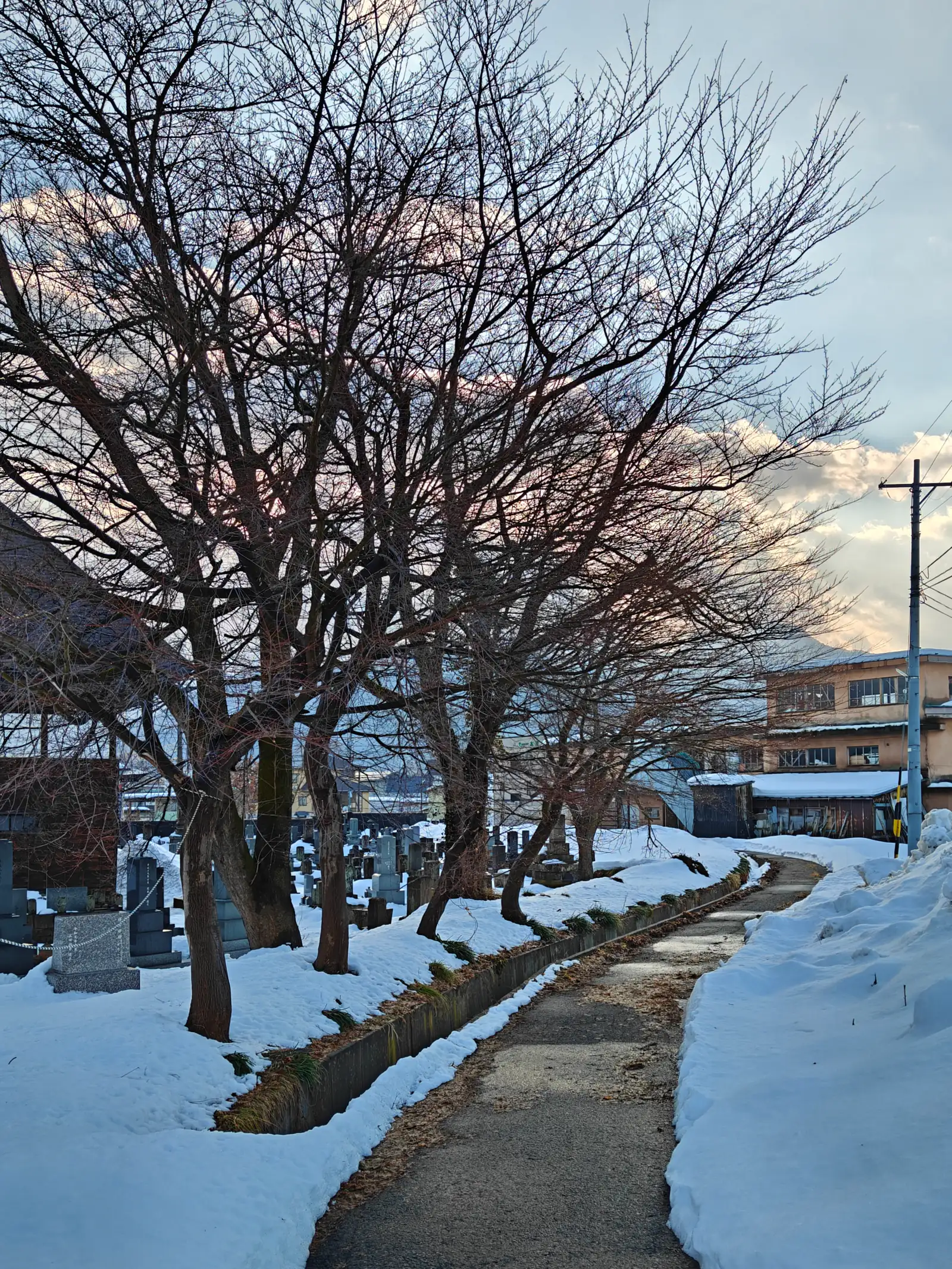
A cleared footpath curves between snowbanks past a row of bare trees and a snow-covered cemetery, with an old multi-storey building and a utility pole on the right.

Two nights in Nozawa Onsen for the fire festival

11 h 54 min · About ¥35,810 · Moderate pace
  1. StartIiyama Station 飯山駅いいやまえき

    25 min by bus · Nozawa Onsen Liner · ¥600

  2. Stay 30 minThe water runs very hot. Ask the others before you turn on the cold tap.

    Your first night: the newest of the 13 free baths, a bit outside the centre. Around the festival the baths in the centre are packed, and this one was empty.

    14 min on foot

  3. Stay 5 hBook the rental online the day before, which is cheaper than on the day, and buy your lift pass ahead to skip the long line.

    Festival day starts on the slopes. Rent everything at a shop a minute from the gondola, then ride it about 8 minutes up. Lockers at the top keep what you don't need while you ski.

    9 min on foot

  4. Stay 20 minLeave a few coins in the box by the door: the bath is free, and the villagers keep it.

    Walk back into the main square for the village's symbol, a bathhouse still built as it was in the Edo period. It's the most beautiful from outside, but smaller than you'd think: most of these baths take three or four people at once.

    6 min on foot

  5. Stay 4 hYou need the entry ticket your inn gives you, and you can't bring drinks in.

    The square where the fire festival is held. Come before 7pm, while it's being set up, for a spot in front of the shrine, and stay until it burns, just after 10pm.

    25 min by bus · Nozawa Onsen Liner · ¥600

  6. Stay 30 min

    On your way home, give Iiyama half an hour before your Shinkansen. About 10 minutes north of the station, its temple quarter still holds some twenty temples, beautiful under snow, and this one is the pick.

    15 min on foot

  7. Back atIiyama Station 飯山駅いいやまえき

Map of Nozawa Onsen with the 5 numbered stops of the itinerary and the route between them© OpenStreetMap
  • Bus
  • Walk

Japanese for the trip

Say it there

  • リフト一いち日にち券けんを一いち枚まいください。

    One one-day lift pass, please.

  • 水みずを入いれてもいいですか。

    May I add some cold water?

  • タオルはありますか。

    Do you have a towel?

  • 予約よやくしています。

    I have a reservation.

  • 祭まつりのチケットはありますか。

    Do you have the festival ticket?

  • これを一ひとつください。

    One of these, please.

Words from this trip

野沢温泉のざわおんせん

Nozawa Onsen

  • 野沢のざわNozawa
  • 温泉おんせんhot spring
  • 散歩さんぽwalk
  • 雪ゆきsnow
  • 湯ゆhot water
  • 祭まつりfestival
  • スキーskiing
  • 予約よやくreservation
  • 無料むりょうfree (of charge)
  • 民宿みんしゅくguest house
  • 入浴にゅうよくbathing
  • 源泉げんせんsource (of a spring, etc.)
  • 厄年やくどしunlucky year
  • 社殿しゃでん(main building of a) Shinto shrine
  • 神事しんじShinto ritual
  • 外湯そとゆcommunal hot spring bath
  • 男湯おとこゆmen's bath
  • 女湯おんなゆwomen's bath
  • 野沢菜のざわなnozawana (pickled turnip greens)
  • 温泉おんせんたまごhot-spring soft-boiled egg
  • 道祖神どうそじんtraveller's guardian deity

New trips, by email

When a new trip goes up, we’ll send you the link.

One email when a new trip goes up, nothing else. Every email has a link to leave. Privacy

Useful links

Written by Maxime Pitaval

Maxime in a yukata on a red footbridge to a small shrine in Koyasan

I first came to Japan in 2023 on a two-week organised tour, came back in 2025 for a month on my own, and have lived in Tokyo since January 2026. I only write up places I’ve been to myself: the photos are mine unless a caption credits someone else, and every practical fact is dated and linked to the page it came from, under Fact checks.